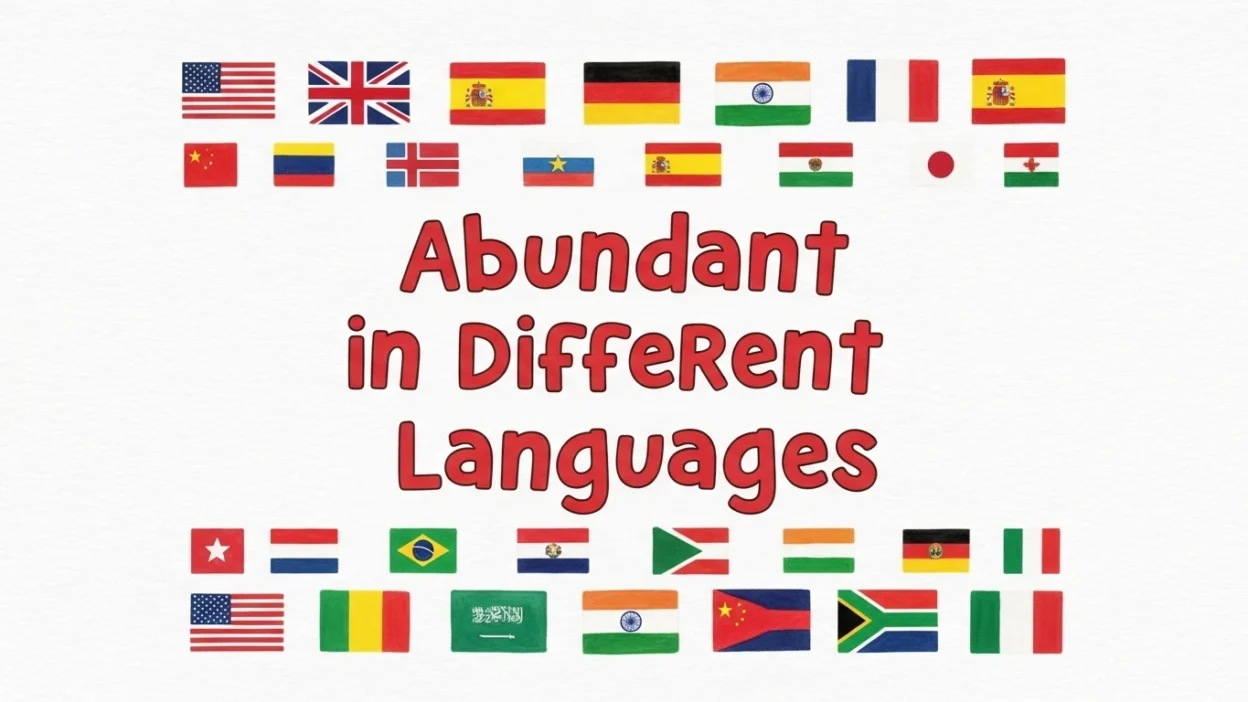
The word abundant expresses the idea of having plenty, being rich in quantity, or existing in large supply. It is commonly used when talking about nature, resources, opportunities, wealth, emotions, and everyday life. Learning abundant in different languages helps language learners, writers, travelers, and global audiences communicate more clearly across cultures.
This article provides a clear, user-friendly guide on how to say abundant in different languages, with accurate native translations and easy English pronunciations, carefully optimized for search intent and featured snippets.
Abundant in Different Languages Around the World
The table below shows exactly 110 different languages in one clean, mobile-friendly format. Each row includes the language or country reference, the correct native phrase for “abundant,” and a simple pronunciation to make learning easy.
| Language | Native Phrase | Easy English Pronunciation |
| English | Abundant | uh-bun-duhnt |
| French | Abondant | a-bon-don |
| Spanish | Abundante | a-boon-dan-te |
| Portuguese | Abundante | a-boon-dan-che |
| Italian | Abbondante | ab-bon-dan-te |
| German | Reichlich | rye-kh-likh |
| Dutch | Overvloedig | o-ver-vloo-dikh |
| Swedish | Riklig | rik-lig |
| Norwegian | Rikelig | ree-ke-lig |
| Danish | Rigelig | ree-geh-lig |
| Finnish | Runsas | run-sas |
| Icelandic | Nægur | nye-gur |
| Russian | Обильный | a-bil-nee |
| Ukrainian | Рясний | rias-nee |
| Polish | Obfity | ob-fee-tee |
| Czech | Hojný | hoy-nee |
| Slovak | Hojný | hoy-nee |
| Hungarian | Bőséges | bur-shay-gesh |
| Romanian | Abundent | a-boon-dent |
| Bulgarian | Изобилен | ee-zo-bee-len |
| Serbian | Обилан | o-bee-lan |
| Croatian | Obilan | o-bee-lan |
| Slovenian | Obilen | o-bee-len |
| Greek | Άφθονος | af-tho-nos |
| Turkish | Bol | bol |
| Arabic | وفير | wa-feer |
| Hebrew | שופע | sho-feh-ah |
| Persian | فراوان | fa-ra-van |
| Urdu | وافر | waa-fir |
| Hindi | प्रचुर | pra-chur |
| Punjabi | ਵਾਫ਼ਰ | waa-far |
| Bengali | প্রাচুর্যপূর্ণ | pra-chur-jo-purn |
| Tamil | மிகுந்த | mee-gun-tha |
| Telugu | సమృద్ధిగా | sa-mrid-dhi-ga |
| Kannada | ಸಮೃದ್ಧ | sa-mrid-dha |
| Malayalam | സമൃദ്ധമായ | sa-mrid-da-ma-ya |
| Marathi | मुबलक | moo-bu-lak |
| Gujarati | ભરપૂર | bhar-pur |
| Nepali | प्रशस्त | pra-shas-ta |
| Sinhala | ප්රචුර | pra-chu-ra |
| Thai | อุดมสมบูรณ์ | oo-dom-sa-mboon |
| Lao | ອຸດົມສົມບູນ | oo-dom-som-boon |
| Vietnamese | Dồi dào | zoy-zow |
| Khmer | សម្បូរបែប | som-bo-bep |
| Chinese Mandarin | 丰富的 | fung-foo |
| Cantonese | 豐富 | fung-foo |
| Japanese | 豊富な | hoy-foo-ku-na |
| Korean | 풍부한 | poong-boo-han |
| Mongolian | Элбэг | el-beg |
| Indonesian | Berlimpah | ber-lim-pah |
| Malay | Melimpah | meh-lim-pah |
| Filipino | Sagana | sa-ga-na |
| Javanese | Kathah | ka-thah |
| Sundanese | Loba | lo-ba |
| Swahili | Tele | te-le |
| Zulu | Iningi | ee-nin-gi |
| Xhosa | Ininzi | ee-nin-zi |
| Afrikaans | Oorvloedig | oor-vloo-dikh |
| Amharic | በቂ | be-kee |
| Hausa | Yalwa | yal-wa |
| Yoruba | Pupọ̀ | poo-po |
| Igbo | Ọtụtụ | o-to-tee |
| Somali | Badan | ba-dan |
| Malagasy | Be dia | beh dee-ah |
| Esperanto | Abunda | a-boon-da |
| Latin | Abundans | a-boon-dans |
| Welsh | Digonedd | di-go-neth |
| Irish | Flúirseach | floo-er-shakh |
| Scottish Gaelic | Pailt | palt |
| Basque | Ugari | oo-ga-ree |
| Catalan | Abundant | a-boon-dant |
| Galician | Abundante | a-boon-dan-te |
| Maltese | Abbundanti | ab-bun-dan-tee |
| Latvian | Bagātīgs | ba-gaa-tigs |
| Lithuanian | Gausus | gow-sus |
| Estonian | Külluslik | kyoo-lus-lik |
| Albanian | I bollshëm | ee bol-shum |
| Macedonian | Изобилен | ee-zo-bee-len |
| Armenian | Առատ | a-rat |
| Georgian | უხვი | ukh-vi |
| Kazakh | Мол | mol |
| Uzbek | Mo‘l | mol |
| Tajik | Фаровон | fa-ra-von |
| Pashto | ډېر | der |
| Kurdish | Pirr | pir |
| Tibetan | མང་པོ | mang-po |
| Maori | Nui | noo-ee |
| Samoan | Tele | te-le |
| Hawaiian | Nui loa | noo-ee lo-ah |
| Fijian | Levu | le-voo |
| Tongan | Lahi | la-hee |
How to Say Abundant in Different Languages
Knowing how to say abundant in different languages is helpful for writing, translation, travel, and cultural understanding. Some languages express abundance with one simple word, while others use descriptive phrases to show richness or fullness.
Abundant in Different Languages Translations Explained
Abundant in different languages translations may vary based on context. The word can describe physical quantity, emotional richness, natural resources, or opportunities, depending on how it is used.
Abundant in Different Languages in All Languages
Exploring abundant in different languages in all languages highlights how cultures express ideas of plenty, prosperity, and richness, even though linguistic expressions differ.
Conclusion
Learning abundant in different languages expands your vocabulary and helps you express the idea of plenty clearly across cultures. No matter the language, abundance remains a powerful and positive concept worldwide.
FAQs
What does abundant mean in different languages
It generally means plenty, rich in quantity, or existing in large amounts.
Is abundant used in formal language
Yes, it is commonly used in both formal and descriptive writing.
Can abundant describe emotions or ideas
Yes, it can describe love, opportunities, resources, and more.
Do all languages have one word for abundant
Some use a single word, while others use descriptive phrases.
Why learn abundant in different languages
It helps with communication, translation, and cultural understanding.