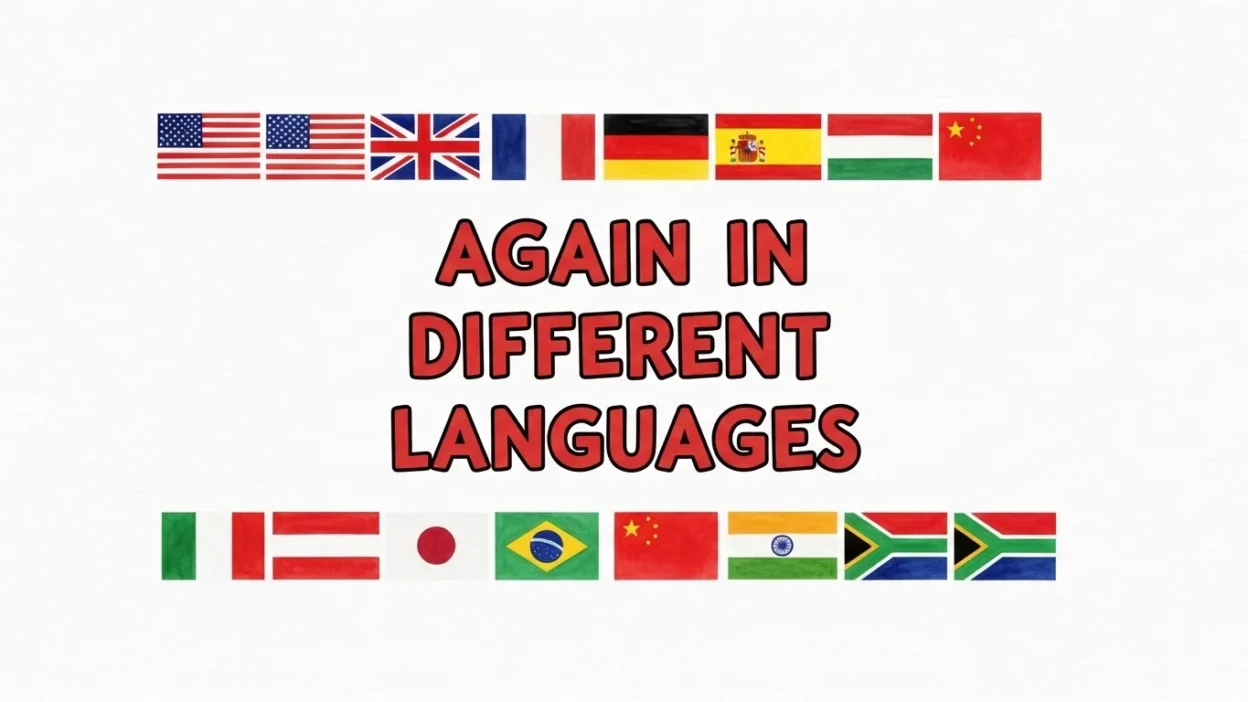
The word again is used every day in conversations, writing, learning, and translations. People search for again in different languages to understand how this common word is expressed worldwide, improve communication, and learn languages more naturally. Knowing how to say again helps with travel, education, subtitles, and global interaction.
This guide clearly explains how to say again in different languages, with correct native words and easy English pronunciation, written for high readability and optimized for search intent.
Again in Different Languages Around the World
Below is a single, clean, mobile-friendly table showing again in different languages with accurate native phrases and simple pronunciations. This table is optimized for featured snippets and quick reference.
| Language / Country | Native Phrase | Easy Pronunciation |
| English | Again | uh-gen |
| Spanish | Otra vez | oh-tra ves |
| French | Encore | on-kor |
| German | Wieder | vee-der |
| Italian | Di nuovo | dee nwo-vo |
| Portuguese | De novo | deh no-vo |
| Dutch | Opnieuw | op-new |
| Russian | Снова | sno-va |
| Ukrainian | Знову | zno-voo |
| Polish | Znowu | zno-voo |
| Czech | Znovu | zno-voo |
| Slovak | Znova | zno-va |
| Hungarian | Újra | ooy-rah |
| Romanian | Din nou | deen no |
| Bulgarian | Отново | ot-no-vo |
| Greek | Ξανά | ksa-na |
| Turkish | Tekrar | tek-rar |
| Arabic | مرة أخرى | mar-ra ukh-ra |
| Hebrew | שוב | shuv |
| Persian | دوباره | do-baa-reh |
| Urdu | دوبارہ | do-baa-ra |
| Hindi | फिर से | phir se |
| Punjabi | ਫਿਰ | phir |
| Bengali | আবার | aa-bar |
| Tamil | மீண்டும் | mee-un-dum |
| Telugu | మళ్లీ | mal-lee |
| Kannada | ಮತ್ತೆ | mat-the |
| Malayalam | വീണ്ടും | vee-un-dum |
| Marathi | पुन्हा | pun-ha |
| Gujarati | ફરી | fa-ree |
| Sinhala | නැවත | na-va-ta |
| Thai | อีกครั้ง | eek krang |
| Vietnamese | Lại | lie |
| Indonesian | Lagi | la-gee |
| Malay | Lagi | la-gee |
| Filipino | Muli | moo-lee |
| Chinese | 再一次 | zai ee-tsuh |
| Japanese | また | ma-ta |
| Korean | 다시 | da-shi |
| Mongolian | Дахин | da-khin |
| Nepali | फेरि | phe-ree |
| Swahili | Tena | teh-na |
| Zulu | Futhi | foo-tee |
| Xhosa | Kwakhona | kwa-ho-na |
| Afrikaans | Weer | veer |
| Amharic | እንደገና | en-de-ge-na |
| Somali | Mar kale | mar ka-le |
| Hausa | Sake | sa-ke |
| Yoruba | Lẹ́ẹ̀kansi | leh-kan-see |
| Igbo | Ọzọ | o-zo |
| Shona | Zvakare | zvah-ka-re |
| Malagasy | Indray | een-dray |
| Maori | Anō | ah-no |
| Samoan | Toe | to-eh |
| Hawaiian | Hou | ho |
| Fijian | Tale | ta-le |
| Estonian | Uuesti | oo-es-tee |
| Latvian | Atkal | at-kal |
| Lithuanian | Vėl | vyel |
| Icelandic | Aftur | af-tur |
| Norwegian | Igjen | ee-yen |
| Swedish | Igen | ee-yen |
| Danish | Igen | ee-yen |
| Finnish | Taas | taas |
| Irish | Arís | a-reesh |
| Welsh | Eto | eh-to |
| Basque | Berriro | beh-ree-ro |
| Catalan | Un altre cop | oon al-truh kop |
| Galician | Outra vez | oh-tra veth |
| Esperanto | Denove | de-no-ve |
| Latin | Iterum | ee-teh-rum |
| Albanian | Përsëri | per-se-ree |
| Bosnian | Ponovo | po-no-vo |
| Croatian | Opet | o-pet |
| Serbian | Опет | o-pet |
| Slovenian | Spet | spet |
| Macedonian | Повторно | po-tor-no |
| Georgian | ისევ | ee-sev |
| Armenian | կրկին | kr-keen |
| Azerbaijani | Yenə | ye-neh |
| Kazakh | Қайта | kai-ta |
| Uzbek | Yana | ya-na |
| Tajik | Боз | boz |
| Pashto | بیا | bee-ya |
| Kurdish | Dîsa | dee-sa |
| Luxembourgish | Erëm | eh-rem |
| Maldivian | ކަލަމެއް | ka-la-meh |
| Lao | ອີກຄັ້ງ | eek khang |
| Khmer | ម្តងទៀត | m-dong tee-et |
Why Learning “Again” in Different Languages Is Useful
Understanding again in different languages around the world improves everyday communication, translation accuracy, and language fluency. It is especially useful in learning, travel, subtitles, and global conversations.
Conclusion
Learning again in different languages helps you communicate more naturally and understand repeated actions across cultures. These translations make global interaction easier and clearer in 2026 and beyond.
FAQs
1. What does again mean in different languages?
Again means repeating an action, expressed with different native words in each language.
2. How to say again in different languages correctly?
Use the native word and pronunciation specific to each language.
3. Is the meaning of again the same worldwide?
Yes, the meaning is similar, though expressions may vary slightly.
4. Why do people search again in different languages?
For learning, translation, communication, and daily language use.
5. Where is again commonly used in other languages?
It is used in conversations, writing, instructions, and education.