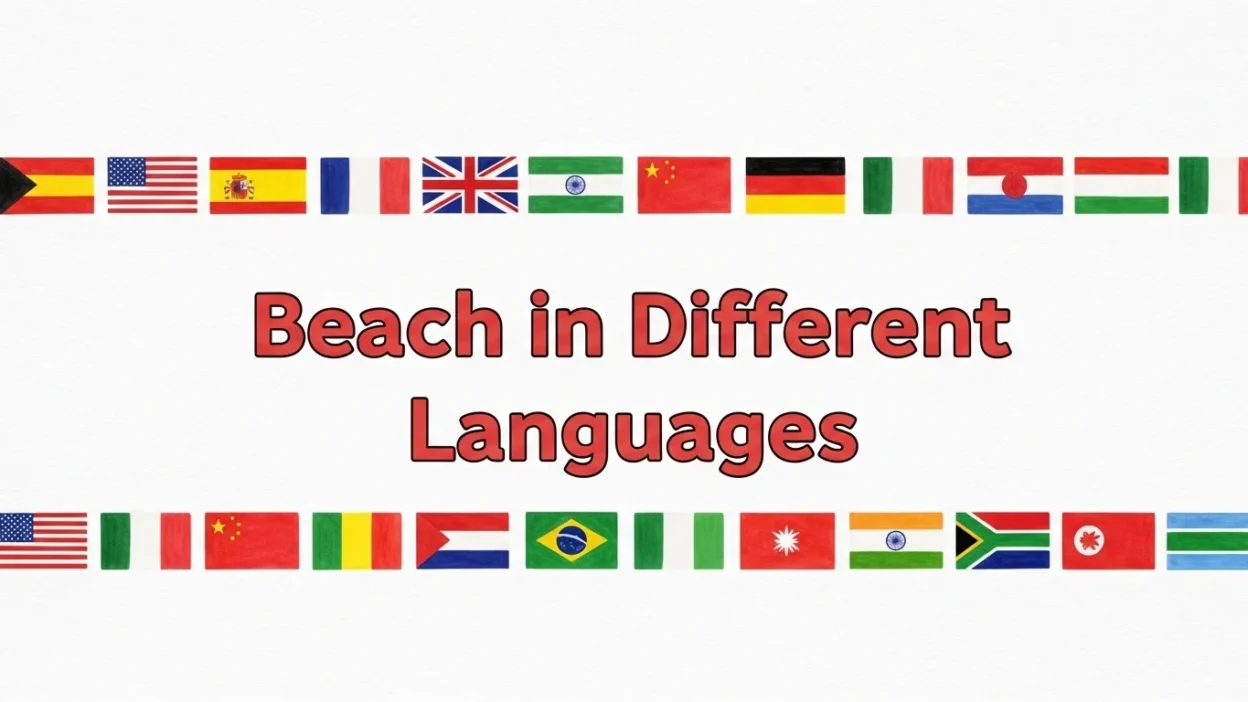
Beaches are loved everywhere for relaxation, travel, culture, and natural beauty. From tropical shores to rocky coastlines, the word beach appears in almost every language, often reflecting geography and lifestyle. Learning beach in different languages is helpful for travelers, language learners, students, and anyone curious about global cultures.
This guide explains how to say beach in different languages, using correct native terms with easy English pronunciations that match real-world usage and informational search intent.
Beach in Different Languages Around the World
The table below shows exactly 110 different languages. Each entry includes the language name, the correct native phrase for beach, and a simple pronunciation. The table is clean, mobile-friendly, and optimized for featured snippets.
| Language | Native Phrase | Easy English Pronunciation |
| English | Beach | beech |
| French | Plage | plahzh |
| Spanish | Playa | ply-ah |
| German | Strand | shtrahnd |
| Italian | Spiaggia | spee-ah-ja |
| Portuguese | Praia | pry-ah |
| Dutch | Strand | strahnd |
| Swedish | Strand | strahnd |
| Norwegian | Strand | strahnd |
| Danish | Strand | strahnd |
| Finnish | Ranta | rahn-tah |
| Icelandic | Strönd | strund |
| Russian | Пляж | plyazh |
| Ukrainian | Пляж | plyazh |
| Polish | Plaża | plah-zha |
| Czech | Pláž | plahzh |
| Slovak | Pláž | plahzh |
| Hungarian | Tengerpart | ten-ger-part |
| Romanian | Plajă | plah-juh |
| Bulgarian | Плаж | plahzh |
| Serbian | Плажа | plah-zha |
| Croatian | Plaža | plah-zha |
| Bosnian | Plaža | plah-zha |
| Slovenian | Plaža | plah-zha |
| Greek | Παραλία | pah-rah-lee-ah |
| Turkish | Plaj | plahj |
| Arabic | شاطئ | sha-ti |
| Hebrew | חוף | khof |
| Persian | ساحل | sah-hel |
| Urdu | ساحل | sahil |
| Hindi | समुद्र तट | sa-mu-dar tat |
| Punjabi | ਸਮੁੰਦਰ ਕੰਢਾ | sa-mun-dar kan-da |
| Bengali | সৈকত | shoi-kot |
| Tamil | கடற்கரை | ka-dar-ka-rai |
| Telugu | బీచ్ | beech |
| Kannada | ಕಡಲತೀರ | ka-da-la-teer |
| Malayalam | കടൽത്തീരം | ka-dal-thee-ram |
| Marathi | समुद्रकिनारा | sa-mu-dra ki-na-ra |
| Gujarati | દરિયાકિનારો | da-ri-ya ki-na-ro |
| Nepali | समुद्र किनार | sa-mu-dra ki-nar |
| Sinhala | වෙරළ | we-ral |
| Thai | ชายหาด | chai-hat |
| Lao | ຫາດ | haat |
| Vietnamese | Bãi biển | bye bien |
| Khmer | ឆ្នេរ | ch-nay |
| Chinese Mandarin | 海滩 | hai-tan |
| Cantonese | 海灘 | hoi-taan |
| Japanese | ビーチ | bee-chi |
| Korean | 해변 | hae-byun |
| Mongolian | Далайн эрэг | da-lain eh-reg |
| Indonesian | Pantai | pan-tie |
| Malay | Pantai | pan-tie |
| Filipino | Dalampasigan | da-lam-pa-see-gan |
| Javanese | Pantai | pan-tie |
| Sundanese | Basisir | ba-see-seer |
| Swahili | Ufukwe | oo-fook-weh |
| Zulu | Ibhishi | ib-bee-shee |
| Xhosa | Ulwandle | oo-lwan-dleh |
| Afrikaans | Strand | strahnd |
| Amharic | ዳርቻ | dar-cha |
| Hausa | Rairayin bakin teku | rye-rye-n bak-in tay-koo |
| Yoruba | Etikun | eh-tee-koon |
| Igbo | Osimiri aja | oh-see-mee-ree ah-ja |
| Somali | Xeeb | heeb |
| Malagasy | Torapasika | to-ra-pa-see-ka |
| Esperanto | Strando | strahn-doh |
| Latin | Litus | lee-tus |
| Welsh | Traeth | tryth |
| Irish | Trá | traw |
| Scottish Gaelic | Tràigh | trah |
| Basque | Hondartza | hon-dar-tsa |
| Catalan | Platja | plat-ja |
| Galician | Praia | pry-ah |
| Maltese | Bajja | bad-ja |
| Latvian | Pludmale | plood-ma-leh |
| Lithuanian | Paplūdimys | pah-ploo-dee-mis |
| Estonian | Rand | rahnd |
| Albanian | Plazh | plahzh |
| Macedonian | Плажа | plah-zha |
| Armenian | Լողափ | lo-ghap |
| Georgian | სანაპირო | sa-na-pee-ro |
| Kazakh | Жағажай | zha-ga-zhai |
| Uzbek | Sohil | so-hil |
| Tajik | Соҳил | so-hil |
| Pashto | ساحل | sahil |
| Kurdish | Plaj | plahj |
| Tibetan | མཚོ་འགྲམ | tso-dram |
| Maori | Takutai | ta-koo-tie |
| Samoan | Matafaga | ma-ta-fa-ga |
| Hawaiian | Kahakai | ka-ha-kai |
| Fijian | Mata ni wasawasa | ma-ta nee wa-sa-wa-sa |
| Tongan | Matafanga | ma-ta-fan-ga |
| Inuit | Imartaq | ee-mar-tak |
How to Say Beach in Different Languages
Learning how to say beach in different languages makes travel smoother and conversations more natural. Some languages use native coastal terms, while others borrow from international words.
Beach in Different Languages Translations Explained
The beach in different languages translations often reflect geography. Island nations and coastal cultures usually have ancient, descriptive words for beaches.
Beach in Different Languages in All Languages
Exploring beach in different languages in all languages highlights how universal coastlines are, even though each culture names them differently.
Conclusion
Knowing beach in different languages helps you connect with cultures, plan trips, and expand vocabulary. One simple word reveals a shared global love for the sea.
FAQs
What is the most common word for beach worldwide
Many languages use unique native words rather than direct translations.
Do all languages have a word for beach
Yes, though landlocked regions may use borrowed or descriptive terms.
Is beach pronunciation similar across languages
Some are similar, but many sound completely different.
Why do beach translations vary so much
They reflect geography, history, and cultural connection to the sea.
Why learn beach in different languages
It improves travel communication and cultural understanding.