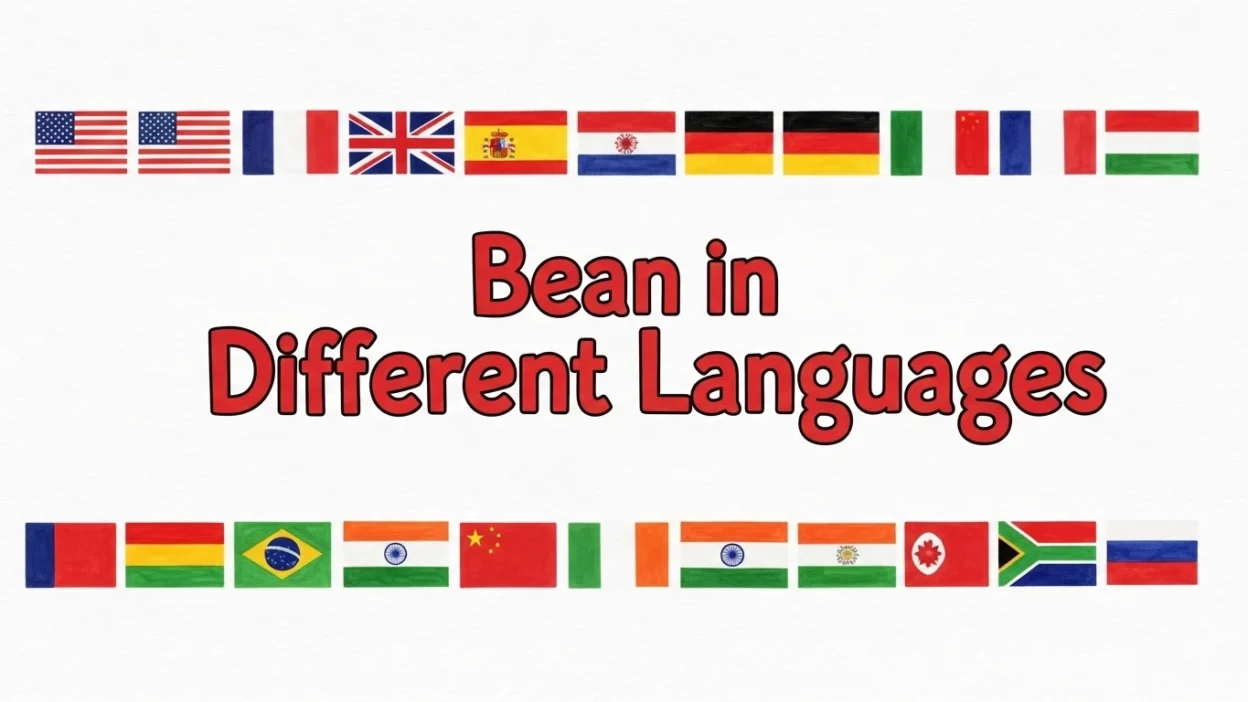
Beans are a staple food across cultures, cuisines, and traditions. From protein-rich meals to everyday cooking, the word bean appears in many languages worldwide. Learning bean in different languages is helpful for travelers, food lovers, students, and anyone curious about global vocabulary.
This guide explains how to say bean in different languages, using correct native words with easy English pronunciations so you can recognize and use them confidently.
Bean in Different Languages Around the World
The table below shows exactly 110 different languages with the native translation of the word bean and a simple pronunciation for each. All languages are displayed together in one clean, mobile-friendly table.
| Language | Native Phrase | Easy English Pronunciation |
| English | Bean | been |
| French | Haricot | ha-ree-ko |
| Spanish | Frijol | free-hol |
| German | Bohne | boh-nuh |
| Italian | Fagiolo | fa-jo-lo |
| Portuguese | Feijão | fay-zhown |
| Dutch | Boon | bone |
| Swedish | Böna | buh-na |
| Norwegian | Bønne | bun-neh |
| Danish | Bønne | bun-neh |
| Finnish | Papu | pa-poo |
| Icelandic | Baun | bow-n |
| Russian | Фасоль | fa-sol |
| Ukrainian | Квасоля | kva-so-lya |
| Polish | Fasola | fa-so-la |
| Czech | Fazole | fa-zo-le |
| Slovak | Fazuľa | fa-zoo-lya |
| Hungarian | Bab | bob |
| Romanian | Fasole | fa-so-le |
| Bulgarian | Боб | bob |
| Serbian | Пасуљ | pa-sool |
| Croatian | Grah | grah |
| Bosnian | Grah | grah |
| Slovenian | Fižol | fee-zhol |
| Greek | Φασόλι | fa-so-lee |
| Turkish | Fasulye | fa-sool-ye |
| Arabic | فاصوليا | fa-soo-li-ya |
| Hebrew | שעועית | sha-wa-eet |
| Persian | لوبیا | loo-bee-ya |
| Urdu | لوبیا | loo-bi-ya |
| Hindi | सेम | sem |
| Punjabi | ਬੀਨ | been |
| Bengali | শিম | shim |
| Tamil | பீன்ஸ் | peens |
| Telugu | బీన్స్ | beens |
| Kannada | ಬೀನ್ಸ್ | beens |
| Malayalam | ബീൻസ് | beens |
| Marathi | बीन्स | beens |
| Gujarati | બીન્સ | beens |
| Nepali | सिमी | si-mee |
| Sinhala | බෝංචි | bohn-chee |
| Thai | ถั่ว | thua |
| Lao | ຖົ່ວ | thua |
| Vietnamese | Đậu | dow |
| Khmer | សណ្តែក | san-dek |
| Chinese Mandarin | 豆 | doh |
| Cantonese | 豆 | dow |
| Japanese | 豆 | ma-me |
| Korean | 콩 | kong |
| Mongolian | Шош | shosh |
| Indonesian | Kacang | ka-chang |
| Malay | Kacang | ka-chang |
| Filipino | Butil | boo-til |
| Javanese | Kacang | ka-chang |
| Sundanese | Kacang | ka-chang |
| Swahili | Maharagwe | ma-ha-rag-we |
| Zulu | Ubhontshisi | oo-bon-shee-see |
| Xhosa | Iimbotyi | eem-bo-tyee |
| Afrikaans | Boon | bone |
| Amharic | ባቄላ | ba-ke-la |
| Hausa | Wake | wa-ke |
| Yoruba | Ewa | eh-wa |
| Igbo | Agwa | ag-wa |
| Somali | Digir | di-geer |
| Malagasy | Tsaramaso | tsa-ra-ma-so |
| Esperanto | Fabo | fa-bo |
| Latin | Faba | fa-ba |
| Welsh | Ffa | fa |
| Irish | Pónaire | po-nuh-re |
| Scottish Gaelic | Pònair | po-nair |
| Basque | Babarrun | ba-bar-run |
| Catalan | Mongeta | mon-je-ta |
| Galician | Feixón | fay-shon |
| Maltese | Fażola | fa-zo-la |
| Latvian | Pupa | poo-pa |
| Lithuanian | Pupelė | poo-pe-le |
| Estonian | Uba | oo-ba |
| Albanian | Fasule | fa-soo-le |
| Macedonian | Грав | grav |
| Armenian | Լոբի | lo-bee |
| Georgian | ლობიო | lo-bee-o |
| Kazakh | Бұршақ | bur-shak |
| Uzbek | Loviya | lo-vee-ya |
| Tajik | Лӯбиё | loo-be-yo |
| Pashto | لوبیا | loo-be-ya |
| Kurdish | Lûbya | loob-ya |
| Tibetan | སྲན་མ | sen-ma |
| Maori | Pīni | pee-nee |
| Samoan | Pini | pee-nee |
| Hawaiian | Pīni | pee-nee |
| Fijian | Bini | bee-nee |
| Tongan | Pini | pee-nee |
| Inuit | Kuannit | koo-an-nit |
How to Say Bean in Different Languages
Understanding how to say bean in different languages is useful when reading recipes, shopping for food abroad, or learning about international cuisines.
Bean in Different Languages Translations and Meaning
The bean in different languages translations often reflect local diets, with some languages using one word for all beans and others having many specific terms.
Bean in Different Languages in All Languages
Exploring bean in different languages in all languages shows how common and important beans are across cultures and regions.
Conclusion
Learning bean in different languages helps expand vocabulary and cultural understanding. Even though the word changes, beans remain a shared food across the world.
FAQs
What is the most common translation of bean?
Many languages use a native agricultural term related to legumes.
Do all languages use one word for bean?
Some languages have one general word, others have multiple specific words.
Is bean used differently in cooking terms?
Yes, some languages change the word based on the bean type.
Are bean translations similar across regions?
Neighboring languages often share similar words.
Why learn bean in different languages?
It helps with travel, food vocabulary, and language learning.