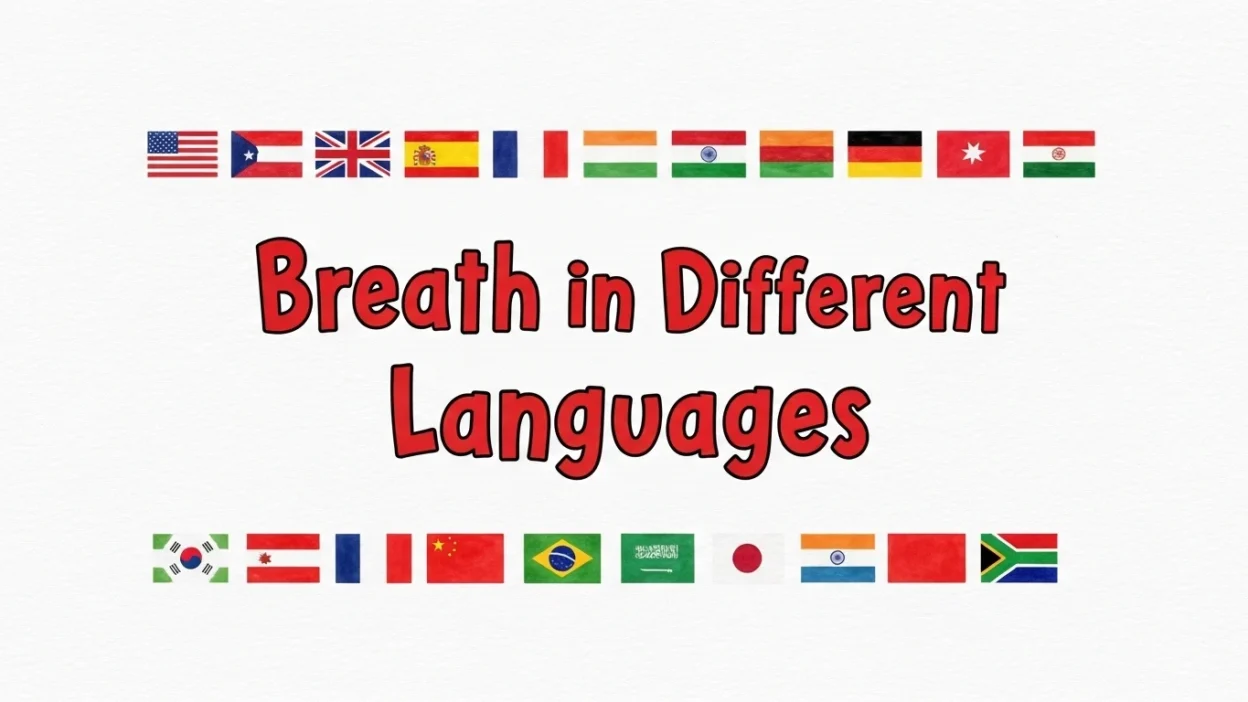
Breath is one of the most basic and meaningful concepts in human life. It connects language, health, emotion, spirituality, and daily expression across cultures. Many people search for breath in different languages to support language learning, travel, writing, education, yoga, meditation, and cultural research.
This guide is designed to help you clearly understand how to say breath in different languages, with accurate translations and easy pronunciations that match real-world usage.
Breath in Different Languages Around the World
The table below presents exactly 110 different languages. Each entry includes the language name, the correct native word for “breath,” and an easy English pronunciation. The table is clean, mobile-friendly, and optimized for featured snippets.
| Language | Native Phrase | Easy English Pronunciation |
| English | Breath | breth |
| French | Souffle | soo-fl |
| Spanish | Aliento | ah-lyen-to |
| German | Atem | ah-tem |
| Italian | Respiro | res-pee-ro |
| Portuguese | Respiração | res-pee-ra-sown |
| Dutch | Adem | ah-dem |
| Swedish | Andedräkt | an-de-drakt |
| Norwegian | Pust | poost |
| Danish | Åndedræt | on-de-dret |
| Finnish | Hengitys | hen-gi-toos |
| Icelandic | Andardráttur | an-dar-drat-tur |
| Russian | Дыхание | duh-kha-nee-ye |
| Ukrainian | Дихання | di-khan-nya |
| Polish | Oddech | od-dekh |
| Czech | Dech | dekh |
| Slovak | Dych | dikh |
| Hungarian | Lélegzet | lay-leg-zet |
| Romanian | Respirație | res-pee-ra-tsi-ye |
| Bulgarian | Дъх | duh |
| Serbian | Dah | dah |
| Croatian | Dah | dah |
| Bosnian | Dah | dah |
| Slovenian | Dih | dee |
| Greek | Αναπνοή | a-na-pno-ee |
| Turkish | Nefes | neh-fes |
| Arabic | نَفَس | na-fas |
| Hebrew | נשימה | ne-shee-ma |
| Persian | نفس | na-fas |
| Urdu | سانس | saans |
| Hindi | साँस | saans |
| Punjabi | ਸਾਹ | saah |
| Bengali | শ্বাস | shash |
| Tamil | மூச்சு | moo-chu |
| Telugu | శ్వాస | shvaa-sa |
| Kannada | ಉಸಿರು | u-si-ru |
| Malayalam | ശ്വാസം | shvaa-sam |
| Marathi | श्वास | shvaas |
| Gujarati | શ્વાસ | shvaas |
| Nepali | सास | saas |
| Sinhala | හුස්ම | hoos-ma |
| Thai | ลมหายใจ | lom-hai-jai |
| Lao | ລົມຫາຍໃຈ | lom-hai-jai |
| Vietnamese | Hơi thở | hoy tho |
| Khmer | ដង្ហើម | dong-haerm |
| Chinese (Mandarin) | 呼吸 | hoo-shee |
| Cantonese | 呼吸 | foo-kap |
| Japanese | 呼吸 | ko-kyuu |
| Korean | 숨 | soom |
| Mongolian | Амьсгал | am-sgal |
| Indonesian | Napas | na-pas |
| Malay | Nafas | na-fas |
| Filipino | Hininga | hi-ning-a |
| Javanese | Ambegan | am-be-gan |
| Sundanese | Napas | na-pas |
| Swahili | Pumzi | poom-zee |
| Zulu | Umoya | oo-moy-a |
| Xhosa | Umoya | oo-moy-a |
| Afrikaans | Asem | aa-sem |
| Amharic | እስትንፋስ | es-tin-fas |
| Hausa | Numfashi | num-fa-shee |
| Yoruba | Mimi | mee-mee |
| Igbo | Ume | oo-me |
| Somali | Neef | neef |
| Malagasy | Fofonaina | fo-fo-nai-na |
| Esperanto | Spiro | spee-ro |
| Latin | Spiritus | spee-ree-tus |
| Welsh | Anadl | an-adl |
| Irish | Anáil | a-nawl |
| Scottish Gaelic | Anail | a-nal |
| Basque | Arnasa | ar-na-sa |
| Catalan | Alè | a-leh |
| Galician | Alento | a-len-to |
| Maltese | Nifs | nifs |
| Latvian | Elpa | el-pa |
| Lithuanian | Kvėpavimas | kveh-pa-vi-mas |
| Estonian | Hingamine | hin-ga-mi-ne |
| Albanian | Frymë | fruh-muh |
| Macedonian | Дишење | di-she-nye |
| Armenian | Շունչ | shoonch |
| Georgian | სუნთქვა | soon-tkva |
| Kazakh | Тыныс | tuh-niss |
| Uzbek | Nafas | na-fas |
| Tajik | Нафас | na-fas |
| Pashto | ساه | saah |
| Kurdish | Nefes | ne-fes |
| Tibetan | དབུགས | uk |
| Maori | Hā | haa |
| Samoan | Manava | ma-na-va |
| Hawaiian | Hanu | ha-noo |
| Fijian | Manava | ma-na-va |
| Tongan | Manava | ma-na-va |
| Inuit | Anersaartorneq | a-ner-sar-tor-nek |
How to Say Breath in Different Languages
Learning how to say breath in different languages is useful for health, meditation, yoga, poetry, and everyday conversation. The word often carries both physical and symbolic meaning.
Breath in Different Languages Translations and Meaning
Breath in different languages translations often overlap with ideas of life force, spirit, calmness, and energy, making the word culturally rich and meaningful.
Breath in Different Languages in All Languages
Exploring breath in different languages in all languages reveals how deeply connected breathing is to human expression across the world.
Conclusion
Understanding breath in different languages helps bridge language, culture, and human experience. It is a simple word with universal importance and deep meaning.
FAQs
What does breath mean in most languages
It refers to the act of breathing or the air taken into the lungs.
Is breath translated the same way everywhere
No, many languages connect breath with spirit or life force.
Why is breath important in language learning
It appears often in health, emotions, and daily speech.
Are breath and breathing the same word
Some languages use the same word, others separate them.
Is breath used symbolically worldwide
Yes, it often represents life, calm, or energy.