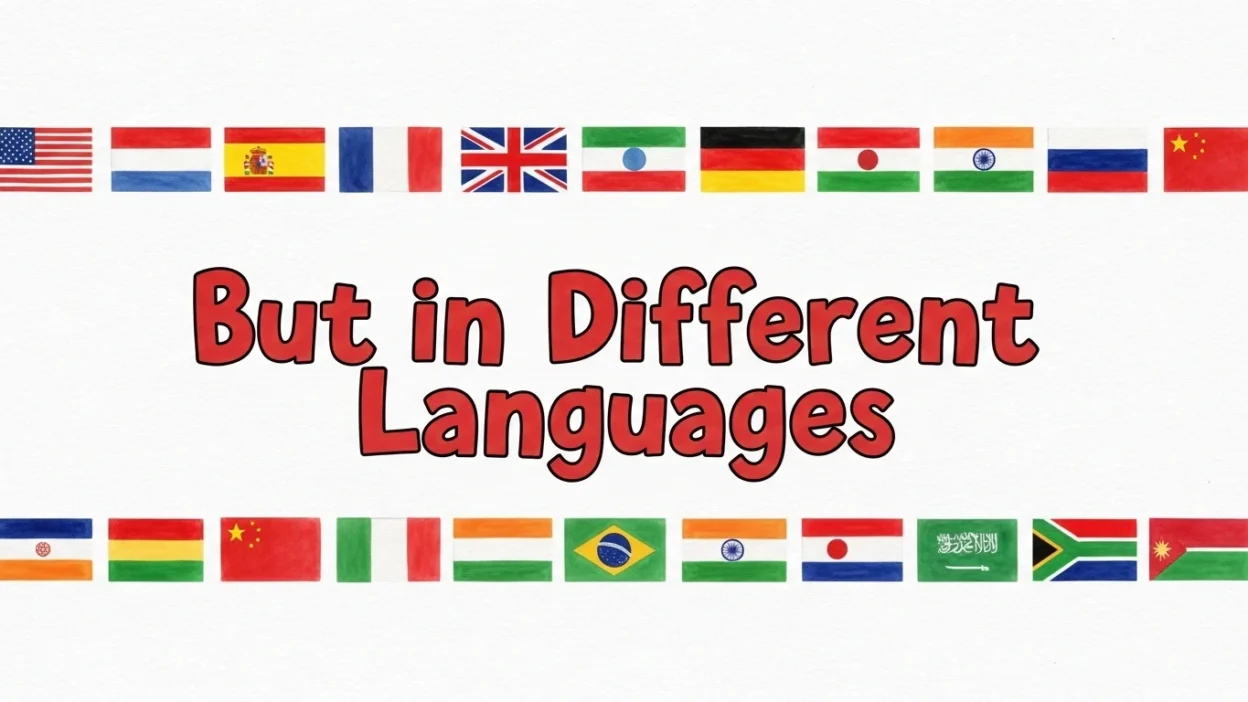
The word “but” is one of the most important connectors in any language. It is used to contrast ideas, add clarity, and create natural flow in sentences. Many learners, writers, translators, and travelers search for but in different languages to improve communication and understand global language structure.
This guide explains the value of this small but powerful word and shows how but in different languages in all languages appears across cultures, with accurate translations and simple pronunciations.
But in Different Languages Around the World
Below is a clean, mobile-friendly table showing exactly 110 different languages. Each entry includes the language name, the correct native word or phrase for “but,” and an easy English pronunciation. This format is optimized for readability and featured snippets.
| Language | Native Phrase | Easy English Pronunciation |
| English | But | but |
| French | Mais | may |
| Spanish | Pero | peh-ro |
| German | Aber | ah-ber |
| Italian | Ma | ma |
| Portuguese | Mas | mash |
| Dutch | Maar | mar |
| Swedish | Men | men |
| Norwegian | Men | men |
| Danish | Men | men |
| Finnish | Mutta | moo-ta |
| Icelandic | En | en |
| Russian | Но | no |
| Ukrainian | Але | ah-le |
| Polish | Ale | ah-le |
| Czech | Ale | ah-le |
| Slovak | Ale | ah-le |
| Hungarian | De | de |
| Romanian | Dar | dar |
| Bulgarian | Но | no |
| Serbian | Ali | ah-lee |
| Croatian | Ali | ah-lee |
| Bosnian | Ali | ah-lee |
| Slovenian | Ampak | am-pak |
| Greek | Αλλά | a-la |
| Turkish | Ama | a-ma |
| Arabic | لكن | la-kin |
| Hebrew | אבל | a-val |
| Persian | اما | a-ma |
| Urdu | لیکن | le-kin |
| Hindi | लेकिन | le-kin |
| Punjabi | ਪਰ | par |
| Bengali | কিন্তু | kin-tu |
| Tamil | ஆனால் | aa-naal |
| Telugu | కానీ | kaa-nee |
| Kannada | ಆದರೆ | aa-da-re |
| Malayalam | പക്ഷേ | pak-she |
| Marathi | पण | pan |
| Gujarati | પરંતુ | pa-ran-tu |
| Nepali | तर | tar |
| Sinhala | නමුත් | na-muth |
| Thai | แต่ | tae |
| Lao | ແຕ່ | tae |
| Vietnamese | Nhưng | nyung |
| Khmer | ប៉ុន្តែ | pon-tae |
| Chinese (Mandarin) | 但是 | dan-shir |
| Cantonese | 但係 | daan-hai |
| Japanese | でも | de-mo |
| Korean | 하지만 | ha-ji-man |
| Mongolian | Гэхдээ | gehk-de |
| Indonesian | Tapi | ta-pee |
| Malay | Tetapi | te-ta-pee |
| Filipino | Pero | pe-ro |
| Javanese | Nanging | na-ning |
| Sundanese | Tapi | ta-pee |
| Swahili | Lakini | la-kee-nee |
| Zulu | Kodwa | ko-dwa |
| Xhosa | Kodwa | ko-dwa |
| Afrikaans | Maar | mar |
| Amharic | ግን | gin |
| Hausa | Amma | am-ma |
| Yoruba | Ṣùgbọ́n | shoo-gbon |
| Igbo | Mana | ma-na |
| Somali | Laakiin | la-kin |
| Malagasy | Fa | fa |
| Esperanto | Sed | sed |
| Latin | Sed | sed |
| Welsh | Ond | ond |
| Irish | Ach | akh |
| Scottish Gaelic | Ach | akh |
| Basque | Baina | bai-na |
| Catalan | Però | pe-ro |
| Galician | Pero | pe-ro |
| Maltese | Imma | im-ma |
| Latvian | Bet | bet |
| Lithuanian | Bet | bet |
| Estonian | Aga | a-ga |
| Albanian | Por | por |
| Macedonian | Но | no |
| Armenian | Բայց | bays |
| Georgian | მაგრამ | mag-ram |
| Kazakh | Бірақ | bi-rak |
| Uzbek | Ammo | am-mo |
| Tajik | Аммо | am-mo |
| Pashto | خو | kho |
| Kurdish | Lê | le |
| Tibetan | འོན་ཀྱང | on-kyang |
| Maori | Engari | e-nga-ri |
| Samoan | Ae | ah-eh |
| Hawaiian | Akā | a-kah |
| Fijian | Ia | ee-ah |
| Tongan | Ka | ka |
| Inuit | Kisianni | ki-see-an-ni |
How to Say But in Different Languages
Learning how to say but in different languages is essential for forming correct sentences. This word often changes position and tone depending on grammar rules, making it a key part of fluency.
But in Different Languages Translations Explained
But in different languages translations usually serve the same contrast function, though some languages use different forms in formal and informal speech. Understanding this improves writing, speaking, and translation accuracy.
But in Different Languages in All Languages
Across cultures, but in different languages in all languages plays a vital role in expressing disagreement, contrast, or exceptions, showing how universal this connector truly is.
Conclusion
The word but in different languages may be short, but its impact is powerful. Knowing these translations helps learners communicate naturally and understand sentence structure across the world.
FAQs
What does the word but mean
It connects contrasting ideas within a sentence.
Is but used the same way in all languages
The meaning is similar, but placement and form may differ.
Why is but important in language learning
It helps express contrast and logical thinking.
Can but have multiple meanings
In some languages, it changes depending on context.
Is but formal or informal
It can be both, depending on the language and usage.