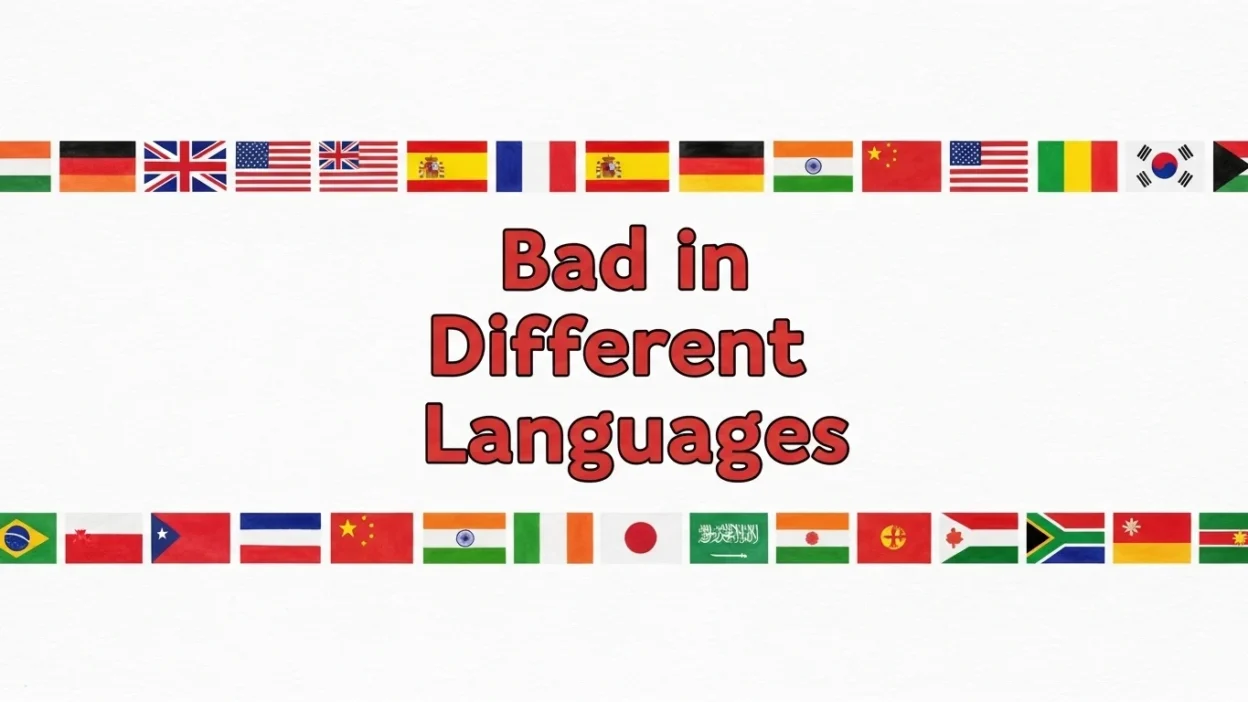
The word bad is one of the most common descriptive terms used worldwide. It expresses negativity, poor quality, wrongdoing, or an unfavorable situation. Learning bad in different languages helps with daily conversations, language learning, translation, writing, and cultural understanding.
This article is designed to fully match informational search intent and clearly explain bad in different languages in all languages, with accurate native words and easy English pronunciations.
Bad in Different Languages Around the World
Below is a clean, mobile-friendly table showing exactly 110 different languages. Each entry includes the language or country, the correct native translation of bad, and an easy pronunciation.
| Language / Country | Native Phrase | Easy Pronunciation |
| English | Bad | bad |
| Spanish | Malo | MA-lo |
| French | Mauvais | moh-VAY |
| German | Schlecht | shlekt |
| Italian | Cattivo | kat-TEE-vo |
| Portuguese | Mau | mao |
| Dutch | Slecht | slekht |
| Swedish | Dålig | DOH-lig |
| Norwegian | Dårlig | DOHR-lig |
| Danish | Dårlig | DOHR-lig |
| Finnish | Huono | HOO-o-no |
| Icelandic | Slæmur | SLYE-mur |
| Russian | Плохой | plok-HOY |
| Ukrainian | Поганий | po-HA-nee |
| Polish | Zły | zlih |
| Czech | Špatný | SHPAT-nee |
| Slovak | Zlý | zlee |
| Hungarian | Rossz | rosh |
| Romanian | Rău | rao |
| Bulgarian | Лош | losh |
| Serbian | Лош | losh |
| Croatian | Loš | losh |
| Slovenian | Slab | slab |
| Greek | Κακός | ka-KOS |
| Turkish | Kötü | kuh-TOO |
| Arabic | سيئ | say-ye |
| Hebrew | רע | rah |
| Persian | بد | bad |
| Urdu | برا | bu-ra |
| Hindi | बुरा | bu-ra |
| Bengali | খারাপ | kha-rap |
| Punjabi | ਮਾੜਾ | MA-ra |
| Gujarati | ખરાબ | kha-rab |
| Marathi | वाईट | va-eet |
| Tamil | மோசமான | mo-sa-MAN |
| Telugu | చెడు | che-du |
| Kannada | ಕೆಟ್ಟ | ket-ta |
| Malayalam | മോശം | mo-sham |
| Sinhala | නරක | na-ra-ka |
| Nepali | खराब | kha-rab |
| Chinese (Mandarin) | 坏 | hwai |
| Cantonese | 壞 | wai |
| Japanese | 悪い | wa-rui |
| Korean | 나쁘다 | na-ppeu-da |
| Thai | แย่ | yeh |
| Vietnamese | Xấu | sao |
| Indonesian | Buruk | BOO-ruk |
| Malay | Buruk | BOO-ruk |
| Filipino | Masama | ma-SA-ma |
| Khmer | អាក្រក់ | a-krok |
| Lao | ບໍ່ດີ | bor-dee |
| Burmese | ဆိုး | soh |
| Mongolian | Муу | moo |
| Kazakh | Жаман | zha-man |
| Uzbek | Yomon | yo-mon |
| Azerbaijani | Pis | pees |
| Georgian | ცუდი | tsu-di |
| Armenian | Վատ | vat |
| Swahili | Mbaya | MBA-ya |
| Zulu | Mbi | mbee |
| Xhosa | Mbi | mbee |
| Afrikaans | Sleg | slekh |
| Hausa | Mummuna | mum-MU-na |
| Yoruba | Buburu | boo-boo-roo |
| Igbo | Ọjọọ | o-JO |
| Amharic | መጥፎ | met-fo |
| Somali | Xun | hoon |
| Estonian | Halb | halb |
| Latvian | Slikts | slikts |
| Lithuanian | Blogas | BLO-gas |
| Irish | Dona | DO-na |
| Scottish Gaelic | Dona | DO-na |
| Welsh | Drwg | droog |
| Basque | Txarra | CHAR-ra |
| Catalan | Dolent | do-LENT |
| Galician | Malo | MA-lo |
| Maltese | Ħażin | ha-zeen |
| Albanian | Keq | kek |
| Macedonian | Лош | losh |
| Bosnian | Loš | losh |
| Luxembourgish | Schlecht | shlekt |
| Maori | Kino | KEE-no |
| Samoan | Leaga | lay-AH-ga |
Meaning of Bad in Different Languages
Across cultures, bad in different languages around the world usually describes something negative, harmful, poor, or undesirable. Context may slightly change its tone or strength.
How to Say Bad in Different Languages Correctly
Understanding pronunciation is key when learning how to say bad in different languages, especially in spoken conversations or translations.
Bad in Different Languages in All Languages
These bad in different languages translations show how a simple English word adapts across scripts, sounds, and cultures.
Conclusion
This guide to bad in different languages provides accurate translations, clear pronunciations, and global usage. It is useful for learners, writers, translators, and anyone exploring world languages.
FAQs
- What does bad mean in most languages?
It generally describes something negative, poor, or harmful. - Is bad always used as an adjective worldwide?
Mostly yes, but some languages use it differently in grammar. - Does pronunciation of bad change by context?
Yes, tone and sentence structure can affect pronunciation. - Are there polite alternatives to bad in other languages?
Many languages use softer words depending on situation. - Why learn bad in different languages?
It improves communication, translation accuracy, and cultural awareness.