Knowing how to say bathroom in different languages is extremely useful when traveling, studying languages, or communicating internationally. The word “bathroom” is one of the most commonly searched everyday terms because it is essential in real-life situations across cultures.
This guide is written to clearly explain bathroom in different languages in all languages, using accurate native words and easy English pronunciations to match true informational search intent.
What Does “Bathroom” Mean in Different Cultures?
The meaning of bathroom can vary across cultures and countries. In some places, a bathroom refers to a room used for bathing and washing, while in others it may specifically mean a toilet or restroom.
For example, in American English, “bathroom” is commonly used for a toilet room, even if there is no bath inside. In British English, people often use the word “toilet” or “loo” instead. These cultural differences make learning bathroom in different languages especially useful for travelers and language learners. often used interchangeably, but cultural preferences vary around the world.
Bathroom in Different Languages Around the World
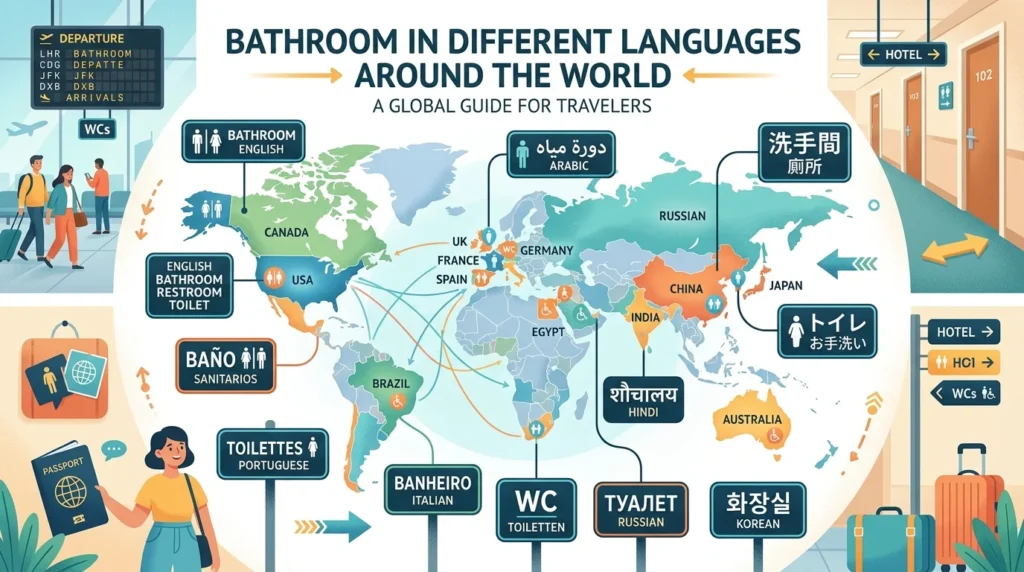
Below is a clean, mobile-friendly table with exactly 110 languages. Each row includes the language or country, the correct native phrase for bathroom, and a simple pronunciation to help you speak with confidence.
| Language / Country | Native Phrase | Easy Pronunciation |
| English | Bathroom | bath-room |
| Spanish | Baño | BAN-yo |
| French | Salle de bain | sal duh ban |
| German | Badezimmer | BAT-suh-tsi-mer |
| Italian | Bagno | BAN-yo |
| Portuguese | Banheiro | ban-YAY-ro |
| Dutch | Badkamer | BAD-ka-mer |
| Swedish | Badrum | BAD-rum |
| Norwegian | Bad | bad |
| Danish | Badeværelse | BA-theh-vair-uh |
| Finnish | Kylpyhuone | KUL-py-hwo-neh |
| Icelandic | Baðherbergi | BATH-her-ber-gee |
| Russian | Ванная | VAN-na-ya |
| Ukrainian | Ванна | VAN-na |
| Polish | Łazienka | wa-ZHEN-ka |
| Czech | Koupelna | KOU-pel-na |
| Slovak | Kúpeľňa | KOO-pel-nya |
| Hungarian | Fürdőszoba | FUR-doh-so-ba |
| Romanian | Baie | BA-ye |
| Bulgarian | Баня | BAN-ya |
| Serbian | Купатило | koo-pa-TEE-lo |
| Croatian | Kupaonica | koo-pa-ON-it-sa |
| Slovenian | Kopalnica | ko-PAL-nit-sa |
| Greek | Μπάνιο | BA-nyo |
| Turkish | Banyo | BAN-yo |
| Arabic | حمام | ham-MAM |
| Hebrew | שירותים | she-ru-TEEM |
| Persian | حمام | ha-MAM |
| Urdu | باتھ روم | bath room |
| Hindi | बाथरूम | bath-room |
| Bengali | বাথরুম | bath-room |
| Punjabi | ਬਾਥਰੂਮ | bath-room |
| Gujarati | બાથરૂમ | bath-room |
| Marathi | स्नानगृह | snaan-grih |
| Tamil | குளியலறை | ku-li-ya-la-rai |
| Telugu | స్నానగది | sna-na-ga-di |
| Kannada | ಸ್ನಾನಗೃಹ | sna-na-gri-ha |
| Malayalam | കുളിമുറി | ku-li-mu-ri |
| Sinhala | නානකාමරය | na-na-ka-ma-ra |
| Nepali | बाथरूम | bath-room |
| Chinese (Mandarin) | 浴室 | yoo-shr |
| Cantonese | 浴室 | yuk-sat |
| Japanese | バスルーム | ba-su-ru-mu |
| Korean | 화장실 | hwa-jang-shil |
| Thai | ห้องน้ำ | hong-nam |
| Vietnamese | Phòng tắm | fong-tam |
| Indonesian | Kamar mandi | KA-mar MAN-di |
| Malay | Bilik mandi | BI-lik MAN-di |
| Filipino | Banyo | BAN-yo |
| Khmer | បន្ទប់ទឹក | ban-top-tuk |
| Lao | ຫ້ອງນ້ຳ | hong-nam |
| Burmese | ရေချိုးခန်း | yay-cho-kan |
| Mongolian | Ариун цэврийн өрөө | a-ryun tsev-rin o-ro |
| Kazakh | Жуынатын бөлме | zhu-yi-na-tyn bol-me |
| Uzbek | Hammom | ham-mom |
| Azerbaijani | Hamam | ha-mam |
| Georgian | აბაზანა | a-ba-za-na |
| Armenian | Լոգարան | lo-ga-ran |
| Swahili | Bafu | BA-foo |
| Zulu | Indlu yangasese | in-dlu yan-ga-SE-se |
| Xhosa | Indlu yangasese | in-dlu yan-ga-SE-se |
| Afrikaans | Badkamer | BAD-ka-mer |
| Hausa | Gidan wanka | GEE-dan WAN-ka |
| Yoruba | Balùwẹ̀ | ba-lu-we |
| Igbo | Ụlọ ịsa ahụ | u-lo ee-sa a-ho |
| Amharic | መታጠቢያ | me-ta-te-BI-ya |
| Somali | Musqul | mus-kul |
| Estonian | Vannituba | VAN-ni-tu-ba |
| Latvian | Vannasistaba | VAN-na-sis-ta-ba |
| Lithuanian | Vonios kambarys | VO-nee-os KAM-ba-ris |
| Irish | Seomra folctha | SHUM-ra FOLK-ha |
| Scottish Gaelic | Seòmar-ionnlaid | SHO-mar IN-lij |
| Welsh | Ystafell ymolchi | us-ta-fel uh-MOL-khi |
| Basque | Bainugela | bai-nu-GE-la |
| Catalan | Bany | BAN-y |
| Galician | Baño | BAN-yo |
| Maltese | Kamra tal-banju | KAM-ra tal BAN-yu |
| Albanian | Banjo | BAN-yo |
| Macedonian | Бања | BAN-ya |
| Bosnian | Kupatilo | koo-pa-TEE-lo |
| Luxembourgish | Buedzëmmer | BOO-et-sum-er |
| Maori | Wharepaku | FA-re-pa-koo |
| Samoan | Faletaele | fa-le-ta-E-le |
Bathroom vs Restroom vs Toilet: What’s the Difference?
Although bathroom, restroom, and toilet are related words, they are used differently depending on the country and situation.
A bathroom usually refers to a room with a bath, shower, or sink.
A restroom is a polite public term commonly used in the United States.
A toilet specifically refers to the sanitation fixture or the room containing it.
In everyday conversation, these words are often used interchangeably, but cultural preferences vary around the world.
Meaning of Bathroom in Different Languages
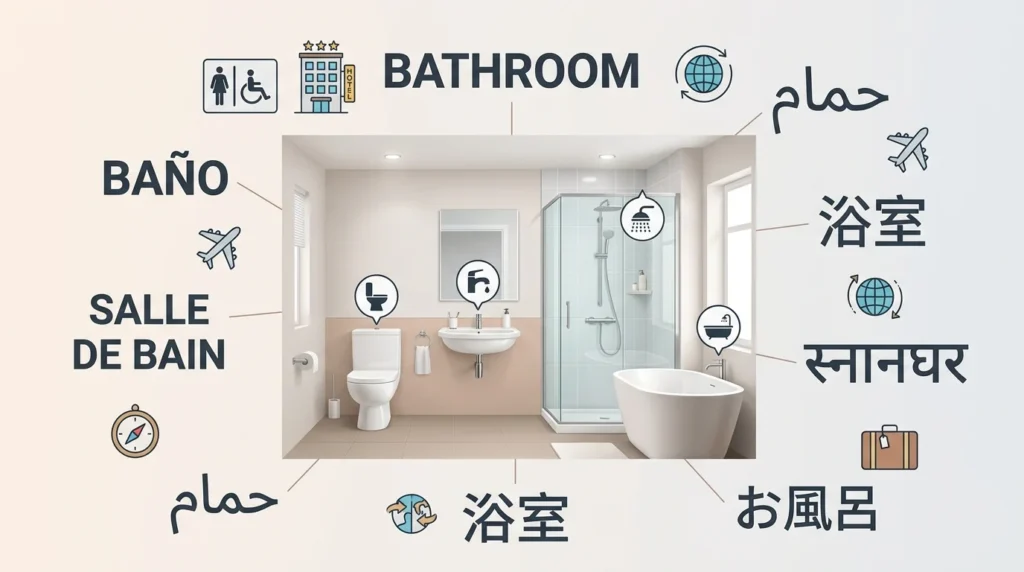
Across cultures, bathroom in different languages around the world may refer to a room for bathing, a toilet, or both. Some languages separate these meanings, while others use one common word.
How to Say Bathroom in Different Languages
Learning how to say bathroom in different languages is especially helpful for travelers, students, and daily conversations in foreign countries.
Bathroom in Different Languages in All Languages
These bathroom in different languages translations show how essential daily needs are expressed differently yet understood universally.
Conclusion
This complete guide to bathroom in different languages provides accurate translations, easy pronunciations, and global coverage. It is practical, clear, and useful for real-life communication worldwide.
FAQs
- What is the most common meaning of bathroom worldwide?
It usually refers to a room used for washing, bathing, or using the toilet. - Do all languages use one word for bathroom and toilet?
No, some languages use separate words depending on usage. - Why is bathroom a common travel phrase?
Because it is essential for daily needs in unfamiliar places. - Is bathroom translated literally in every language?
Not always; some translations reflect cultural habits. - Why learn bathroom in different languages?
It improves communication, travel comfort, and language skills.