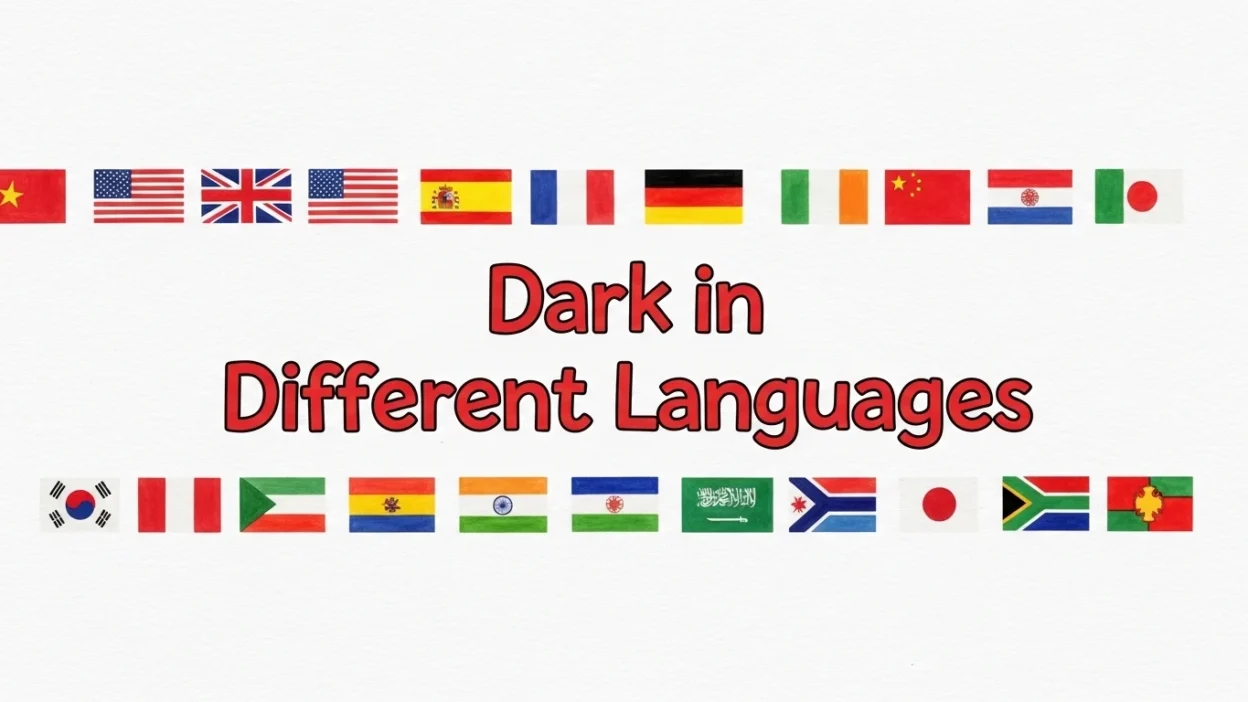
The word dark is used to describe the absence of light, deep colors, moods, and even emotions. Many people search for dark in different languages to expand vocabulary, understand meanings across cultures, or create multilingual content. This article is written to match informational search intent with clear explanations, accurate translations, and easy pronunciation.
Below, you’ll learn how to say dark in different languages, presented in one clean, mobile-friendly table optimized for featured snippets and readability.
Dark in Different Languages
The table below shows dark in different languages around the world, including the language or country flag, the correct native word, and an easy English pronunciation.
| Language / Flag | Native Phrase | Easy English Pronunciation |
| English 🇬🇧 | Dark | dark |
| Spanish 🇪🇸 | Oscuro | os-koo-ro |
| French 🇫🇷 | Sombre | som-bruh |
| German 🇩🇪 | Dunkel | doon-kel |
| Italian 🇮🇹 | Scuro | skoo-ro |
| Portuguese 🇵🇹 | Escuro | es-koo-ro |
| Dutch 🇳🇱 | Donker | don-ker |
| Russian 🇷🇺 | Тёмный | tyom-nee |
| Ukrainian 🇺🇦 | Темний | tem-nee |
| Polish 🇵🇱 | Ciemny | chyem-nee |
| Czech 🇨🇿 | Tmavý | tma-vee |
| Slovak 🇸🇰 | Tmavý | tma-vee |
| Hungarian 🇭🇺 | Sötét | sho-tate |
| Romanian 🇷🇴 | Întunecat | in-too-ne-kat |
| Bulgarian 🇧🇬 | Тъмен | tuh-men |
| Greek 🇬🇷 | Σκοτεινός | sko-ti-nos |
| Turkish 🇹🇷 | Karanlık | ka-ran-luk |
| Arabic 🇸🇦 | مظلم | muz-lim |
| Hebrew 🇮🇱 | כהה | ka-heh |
| Persian 🇮🇷 | تاریک | taa-reek |
| Urdu 🇵🇰 | اندھیرا | an-de-raa |
| Hindi 🇮🇳 | अंधेरा | an-dhe-ra |
| Bengali 🇧🇩 | অন্ধকার | on-dho-kar |
| Punjabi 🇮🇳 | ਹਨੇਰਾ | ha-neh-ra |
| Tamil 🇮🇳 | இருள் | i-rul |
| Telugu 🇮🇳 | చీకటి | chee-ka-tee |
| Kannada 🇮🇳 | ಕತ್ತಲೆ | ka-ta-le |
| Malayalam 🇮🇳 | ഇരുണ്ട | i-run-da |
| Sinhala 🇱🇰 | අඳුරු | an-du-ru |
| Nepali 🇳🇵 | अँध्यारो | an-dhya-ro |
| Thai 🇹🇭 | มืด | muet |
| Lao 🇱🇦 | ມືດ | muet |
| Khmer 🇰🇭 | ងងឹត | ngong-ngit |
| Vietnamese 🇻🇳 | Tối | toy |
| Indonesian 🇮🇩 | Gelap | ge-lap |
| Malay 🇲🇾 | Gelap | ge-lap |
| Filipino 🇵🇭 | Madilim | ma-di-lim |
| Japanese 🇯🇵 | 暗い | ku-rai |
| Korean 🇰🇷 | 어두운 | eo-doo-un |
| Chinese Simplified 🇨🇳 | 黑暗 | hey-an |
| Chinese Traditional 🇹🇼 | 黑暗 | hey-an |
| Mongolian 🇲🇳 | Харанхуй | ha-ran-khuy |
| Kazakh 🇰🇿 | Қараңғы | ka-ran-ghy |
| Uzbek 🇺🇿 | Qorong‘i | ko-ron-gi |
| Georgian 🇬🇪 | ბნელი | bne-lee |
| Armenian 🇦🇲 | Մութ | moot |
| Swahili 🇰🇪 | Giza | gee-za |
| Zulu 🇿🇦 | Mnyama | mnya-ma |
| Xhosa 🇿🇦 | Mnyama | mnya-ma |
| Afrikaans 🇿🇦 | Donker | don-ker |
| Amharic 🇪🇹 | ጨለማ | che-le-ma |
| Somali 🇸🇴 | Madow | ma-dow |
| Hausa 🇳🇬 | Duhu | doo-hoo |
| Yoruba 🇳🇬 | Dúdú | doo-doo |
| Igbo 🇳🇬 | Ọchịchịrị | o-chee-chee-ree |
| Latin 🇻🇦 | Obscurus | ob-skoo-rus |
| Icelandic 🇮🇸 | Dökkur | der-kur |
| Norwegian 🇳🇴 | Mørk | merk |
| Swedish 🇸🇪 | Mörk | merk |
| Danish 🇩🇰 | Mørk | merk |
| Finnish 🇫🇮 | Tumma | tum-ma |
| Estonian 🇪🇪 | Tume | too-me |
| Latvian 🇱🇻 | Tumšs | toomsh |
| Lithuanian 🇱🇹 | Tamsus | tam-soos |
| Albanian 🇦🇱 | Errët | eh-ret |
| Serbian 🇷🇸 | Таман | ta-man |
| Croatian 🇭🇷 | Tamno | tam-no |
| Bosnian 🇧🇦 | Tamno | tam-no |
| Slovenian 🇸🇮 | Temen | te-men |
| Macedonian 🇲🇰 | Темен | te-men |
| Maltese 🇲🇹 | Skur | skoor |
| Irish 🇮🇪 | Dorcha | dor-kha |
| Welsh 🏴 | Tywyll | tu-will |
| Scottish Gaelic 🏴 | Dorcha | dor-kha |
| Basque 🇪🇸 | Ilun | ee-loon |
| Catalan 🇪🇸 | Fosc | fosk |
| Galician 🇪🇸 | Escuro | es-koo-ro |
| Haitian Creole 🇭🇹 | Fènwa | fen-wa |
| Esperanto 🌍 | Malluma | mal-loo-ma |
| Maori 🇳🇿 | Pōuri | po-o-ree |
| Samoan 🇼🇸 | Pogisa | po-gi-sa |
| Tongan 🇹🇴 | Poʻuli | po-oo-lee |
Common Uses of the Word Dark in Different Languages
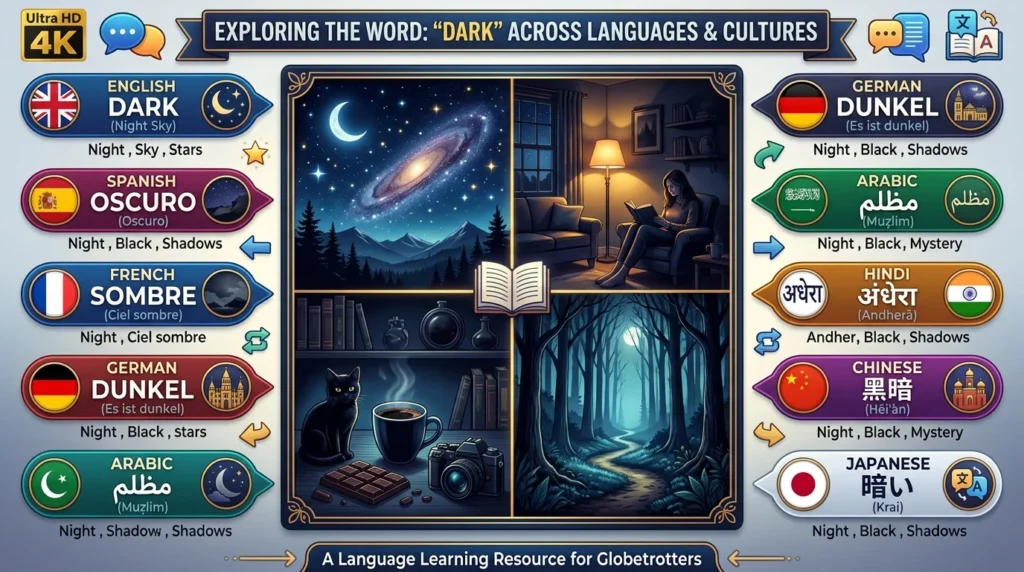
The word “dark” is commonly used to describe the absence of light, dark colors, nighttime conditions, and even emotions. In many languages, the same word may be used for physical darkness as well as symbolic meanings such as mystery, sadness, or seriousness. Learning these variations helps language learners understand real-world usage more accurately.
Why Learning Dark in Different Languages Matters
Understanding dark in different languages translations helps with travel, language learning, literature, and cultural expression, as the word often carries emotional and symbolic meaning.
Dark in Different Languages for Language Learners
Language learners often search for dark in different languages to improve vocabulary and reading comprehension. Since dark is a frequently used adjective in daily conversations, books, movies, and songs, knowing its translation can help learners understand content more naturally across multiple languages.
How to Say Dark in Different Languages Correctly
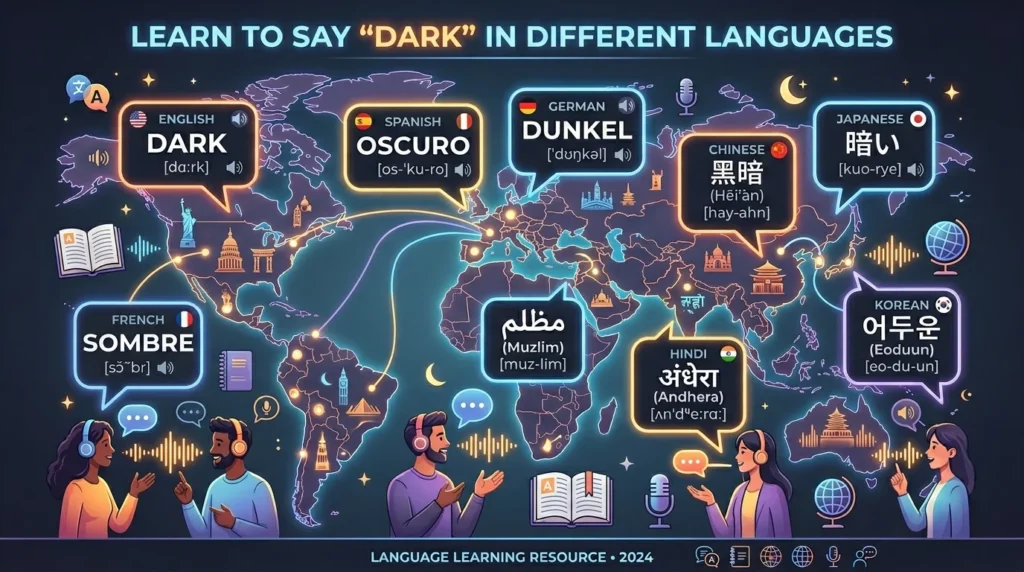
Knowing how to say dark in different languages improves pronunciation accuracy and ensures the correct context is used, whether describing light, color, or mood.
Dark in Different Languages Around the World
Across cultures, dark can mean night, mystery, seriousness, or depth. While words differ, the concept remains universally understood.
Conclusion
This guide to dark in different languages includes 110 accurate translations with easy pronunciations. It’s a helpful resource for learners, writers, and anyone exploring language diversity worldwide.
FAQs
What is dark called in different languages?
Dark is called oscuro, dunkel, karanlık, and many other words globally.
How to say dark in different languages correctly?
Use the native term and follow pronunciation guides for clarity.
Does dark have the same meaning in all cultures?
Mostly yes, though symbolic meanings can vary.
Why learn dark in different languages?
It helps with communication, reading, and cultural understanding.
Are these dark translations commonly used today?
Yes, they are widely used in daily speech and writing.