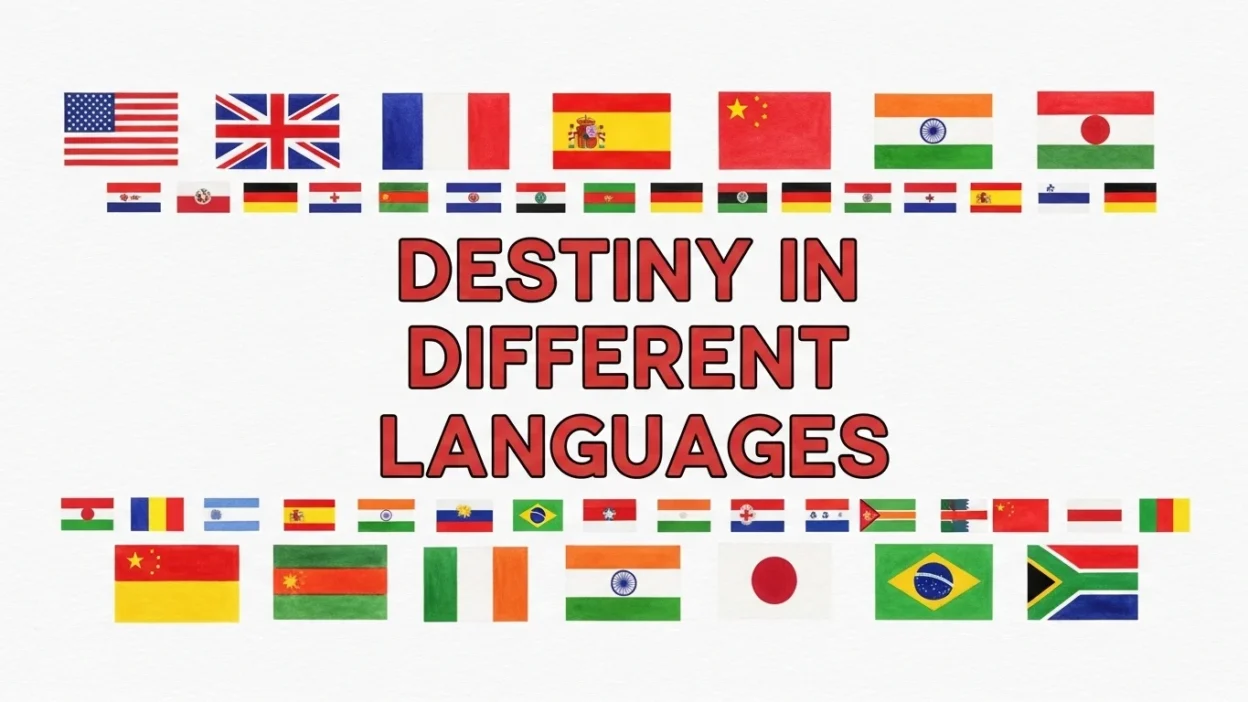
The idea of destiny has fascinated humans for centuries. It represents fate, purpose, and the unseen path guiding our lives. Learning destiny in different languages helps you understand how cultures across the world express life’s direction, fate, and future. This guide is perfect for language learners, writers, students, and anyone curious about global meanings.
Below is a clear, human-friendly explanation followed by destiny in different languages in all languages, carefully structured for readability and featured snippets.
Destiny in Different Languages Around the World
The table below includes exactly 110 languages. Each row shows the language or country, the correct native word for destiny, and an easy English pronunciation.
| Language / Country | Native Phrase | Easy Pronunciation |
| English | Destiny | DES-tuh-nee |
| Spanish | Destino | des-TEE-no |
| French | Destin | des-TAN |
| German | Schicksal | SHIK-saal |
| Italian | Destino | des-TEE-no |
| Portuguese | Destino | des-CHEE-no |
| Dutch | Lot | lot |
| Russian | Судьба | sood-BA |
| Ukrainian | Доля | DO-lya |
| Polish | Przeznaczenie | psheh-zna-CHEH-nye |
| Czech | Osud | OH-sood |
| Slovak | Osud | OH-sood |
| Hungarian | Sors | shors |
| Romanian | Destin | des-TEEN |
| Bulgarian | Съдба | sad-BA |
| Serbian | Sudbina | sood-BEE-na |
| Croatian | Sudbina | sood-BEE-na |
| Slovenian | Usoda | oo-SO-da |
| Greek | Μοίρα | MEE-ra |
| Turkish | Kader | ka-DER |
| Arabic | قدر | QA-dar |
| Hebrew | גורל | go-RAL |
| Persian | سرنوشت | sar-ne-VESHT |
| Urdu | تقدیر | taq-DEER |
| Hindi | भाग्य | BHAAG-ya |
| Bengali | ভাগ্য | BHAAG-go |
| Punjabi | ਕਿਸਮਤ | KIS-mat |
| Gujarati | ભાગ્ય | BHAAG-ya |
| Marathi | नशीब | na-SHEEB |
| Tamil | விதி | VI-thee |
| Telugu | విధి | VI-dhi |
| Kannada | ವಿಧಿ | VI-dhi |
| Malayalam | വിധി | VI-dhi |
| Sinhala | ඉරණම | ee-RA-na-ma |
| Nepali | भाग्य | BHAAG-ya |
| Chinese (Mandarin) | 命运 | ming-YOON |
| Cantonese | 命運 | ming-WAN |
| Japanese | 運命 | oon-MAY |
| Korean | 운명 | oon-MYUNG |
| Thai | โชคชะตา | choke-cha-TAA |
| Vietnamese | Số phận | so-FUN |
| Indonesian | Takdir | TAK-deer |
| Malay | Takdir | TAK-deer |
| Filipino | Kapalaran | ka-pa-LA-ran |
| Khmer | វាសនា | vee-sa-NA |
| Lao | ຊະຕາ | sa-TAA |
| Burmese | ကံကြမ္မာ | kan-KYIN-ma |
| Mongolian | Хувь тавилан | khoov-ta-vee-LAN |
| Kazakh | Тағдыр | TAG-dir |
| Uzbek | Taqdir | TAK-deer |
| Azerbaijani | Tale | TA-leh |
| Georgian | ბედი | BE-dee |
| Armenian | Ճակատագիր | ja-ka-ta-GEER |
| Swahili | Hatima | ha-TEE-ma |
| Zulu | Isiphetho | ee-see-PEH-tho |
| Xhosa | Ikamva | ee-KAM-va |
| Afrikaans | Bestemming | be-STEM-ming |
| Hausa | Kaddara | ka-DA-ra |
| Yoruba | Ayànmọ́ | ah-YAN-moh |
| Igbo | Akara aka | a-KA-ra a-KA |
| Amharic | እጣ ፈንታ | eh-TA fen-TA |
| Somali | Qaddar | QAD-dar |
| Danish | Skæbne | SKAB-neh |
| Swedish | Öde | UR-deh |
| Norwegian | Skjebne | SHYEB-neh |
| Finnish | Kohtalo | KOH-ta-lo |
| Icelandic | Örlög | UR-log |
| Estonian | Saatus | SAA-tus |
| Latvian | Liktenis | LIK-teh-nis |
| Lithuanian | Likimas | LI-ki-mas |
| Irish | Cinniúint | kin-YOONT |
| Scottish Gaelic | Dàn | DAAN |
| Welsh | Tynged | TUNG-ed |
| Basque | Patua | PA-too-a |
| Catalan | Destí | des-TEE |
| Galician | Destino | des-TEE-no |
| Maltese | Destin | des-TEEN |
| Albanian | Fat | faat |
| Macedonian | Судбина | sood-BEE-na |
| Bosnian | Sudbina | sood-BEE-na |
| Luxembourgish | Schicksal | SHIK-saal |
| Tibetan | ལས་འབྲས | leh-DRE |
| Maori | Ika ā-whiro | ee-ka a-FEE-ro |
Why Destiny Has Different Meanings Across Cultures
In some cultures, destiny is seen as fixed and unchangeable. In others, it is shaped by personal choices and actions. Understanding destiny in different languages around the world reveals how societies view fate, effort, and free will.
How to Say Destiny in Different Languages Correctly
When using destiny-related words, context matters. Some languages use the term in spiritual conversations, while others use it casually. Learning pronunciation helps ensure respectful and accurate communication.
Destiny vs Fate in Global Languages
Many languages separate destiny and fate into different words. Destiny often implies purpose, while fate suggests inevitability. These nuances enrich destiny in different languages translations and their real meaning.
Conclusion
Exploring destiny in different languages gives insight into how cultures understand life’s path and purpose. These translations help with language learning, writing, and cultural understanding in a meaningful way.
FAQs
- What does destiny mean in most languages?
Destiny usually refers to a predetermined life path or future shaped by fate or higher forces. - Are destiny and fate the same in all languages?
No, many languages treat destiny and fate as separate concepts with different meanings. - How many languages are included in this guide?
This article includes exactly 110 different languages. - Is destiny a spiritual concept worldwide?
In many cultures it is spiritual, but in others it is philosophical or symbolic. - Can these destiny translations be used in writing and speech?
Yes, all translations are accurate and suitable for general use.