The word east is one of the most important directional terms used in geography, travel, navigation, culture, and daily conversation. Learning how to say east in different languages helps you understand maps, directions, traditions, and regional references across the globe. This guide explains east in different languages with clear translations and easy pronunciations.Whether you are a traveler, student, writer, or language learner, this resource shows how to say east in different languages clearly and correctly.
East in Different Languages Around the World
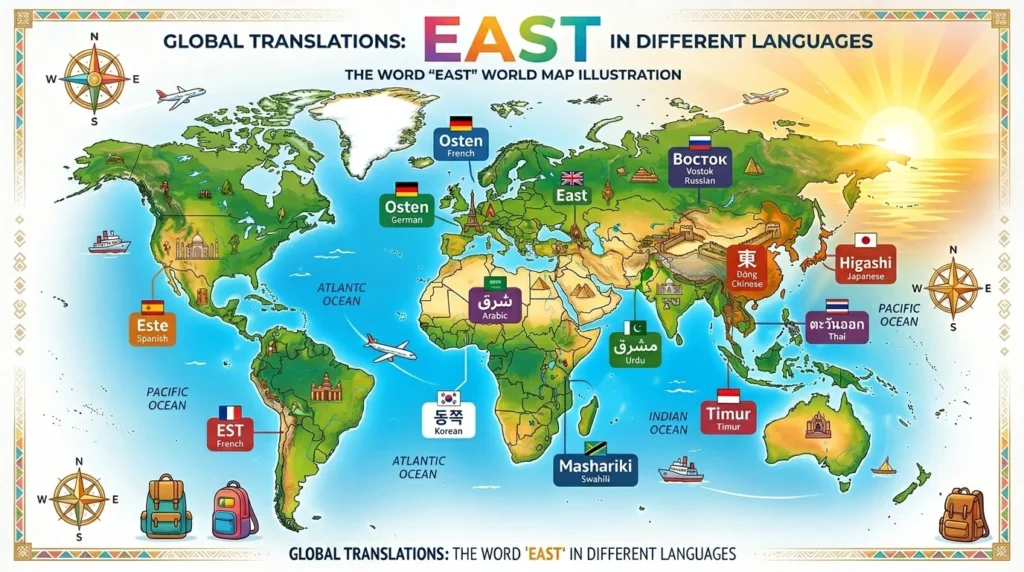
Below is a clean, mobile-friendly table showing east in different languages translations. Each entry includes the language, native word, and easy English pronunciation.
| Language / Flag | Native Word for East | Easy Pronunciation |
| English | East | eest |
| Spanish | Este | ES-teh |
| French | Est | est |
| German | Osten | OH-sten |
| Italian | Est | est |
| Portuguese | Leste | LES-teh |
| Dutch | Oost | ohst |
| Russian | Восток | vos-TOK |
| Ukrainian | Схід | skheed |
| Polish | Wschód | fskhood |
| Czech | Východ | VEE-khod |
| Slovak | Východ | VEE-khod |
| Hungarian | Kelet | KEH-let |
| Romanian | Est | est |
| Greek | Ανατολή | ah-na-to-LEE |
| Turkish | Doğu | DOH-uh |
| Arabic | الشرق | ash-SHARQ |
| Hebrew | מזרח | mee-ZRAKH |
| Persian | شرق | shargh |
| Urdu | مشرق | mash-riq |
| Hindi | पूर्व | poorv |
| Bengali | পূর্ব | pur-bo |
| Punjabi | ਪੂਰਬ | poorb |
| Gujarati | પૂર્વ | poorv |
| Marathi | पूर्व | poorv |
| Tamil | கிழக்கு | ki-ZHAK-ku |
| Telugu | తూర్పు | THOOR-pu |
| Kannada | ಪೂರ್ವ | poor-va |
| Malayalam | കിഴക്ക് | ki-zhak |
| Sinhala | නැගෙනහිර | na-ge-na-hi-ra |
| Thai | ตะวันออก | ta-wan-ORK |
| Vietnamese | Đông | dong |
| Chinese (Mandarin) | 东 | dong |
| Chinese (Cantonese) | 東 | dung |
| Japanese | 東 | hee-ga-shee |
| Korean | 동쪽 | dong-jjok |
| Mongolian | Зүүн | zew-n |
| Indonesian | Timur | TEE-moor |
| Malay | Timur | TEE-moor |
| Filipino | Silangan | see-LA-ngan |
| Swahili | Mashariki | ma-sha-REE-kee |
| Zulu | Empumalanga | em-poo-ma-LAN-ga |
| Afrikaans | Oos | ohs |
| Amharic | ምሥራቅ | mis-RAK |
| Somali | Bari | BA-ree |
| Hausa | Gabas | GA-bas |
| Yoruba | Ìlà-oòrùn | ee-la-OR-run |
| Igbo | Ọwụwa anyanwụ | oh-woo-wa |
| Latin | Oriens | OR-ee-ens |
| Irish | Oirthear | OR-her |
| Welsh | Dwyrain | DWI-rain |
| Scottish Gaelic | Ear | er |
| Icelandic | Austur | OWS-tur |
| Norwegian | Øst | uhst |
| Swedish | Öst | erst |
| Danish | Øst | uhst |
| Finnish | Itä | EE-ta |
| Estonian | Ida | EE-da |
| Latvian | Austrumi | OW-stroo-mee |
| Lithuanian | Rytai | RI-tai |
| Slovenian | Vzhod | vz-hod |
| Croatian | Istok | IS-tok |
| Serbian | Исток | IS-tok |
| Bosnian | Istok | IS-tok |
| Bulgarian | Изток | IZ-tok |
| Albanian | Lindje | LIN-dye |
| Armenian | Արևելք | a-reh-VELK |
| Georgian | აღმოსავლეთი | ah-mo-sa-VEH-tee |
| Kazakh | Шығыс | SHY-ghys |
| Uzbek | Sharq | shark |
| Azerbaijani | Şərq | sherk |
| Pashto | ختیځ | kha-TEEZ |
| Nepali | पूर्व | poorv |
| Tibetan | ཤར | shar |
| Khmer | ខាងកើត | kha-ang-KERT |
| Lao | ທິດຕາເວັນອອກ | tit-ta-wen-ork |
| Burmese | အရှေ့ | a-SHAY |
| Maori | Rāwhiti | RA-wee-tee |
| Samoan | Sasaʻe | sa-sa-eh |
| Tongan | Hahake | ha-HA-ke |
East Symbolism in Different Cultures

In many cultures, the east represents new beginnings, sunrise, hope, and spiritual awakening. Since the sun rises in the east, many civilizations connect this direction with life, energy, and renewal. In Asian traditions, east is often associated with wisdom and balance, while in ancient cultures it symbolized rebirth and guidance. Understanding east in different languages also helps people explore cultural beliefs connected to geography and direction.
Why Learning East in Different Languages Matters
Understanding east in different languages around the world improves navigation, cultural awareness, and language skills. Many cultures use east symbolically for sunrise, beginnings, and direction.
Common Uses of East Across Languages
The word east is used for:
- Directions and maps
- Cultural and historical references
- Travel and geography
- Education and translation work
Differences Between East and Eastern in Various Languages
In many languages, the word east changes slightly when used as an adjective like eastern. Some languages use completely different grammatical forms, while others add prefixes or suffixes. Understanding these small differences helps language learners use directional vocabulary more naturally in speaking and writing.
Conclusion
Knowing east in different languages helps you communicate directions clearly and understand global cultures better. This guide gives accurate, simple, and useful translations for everyday and educational use.
FAQs
1. What does east mean in different languages?
East refers to the cardinal direction where the sun rises in most languages.
2. How to say east in different languages correctly?
Use the native directional term specific to each language and region.
3. Is east translated the same way worldwide?
No, each language has its own word and pronunciation.
4. Why does the east have cultural importance?
Many cultures link east with beginnings, light, and renewal.
5. Is east used in formal and casual speech?
Yes, east is common in both everyday conversation and formal writing.