Numbers are among the first words people learn in any language, and eleven is especially interesting because its structure and sound change widely across cultures. Many learners, travelers, teachers, and translators search for eleven in different languages 600+2026 to understand how this number is spoken and written globally.
This article is designed to match informational search intent and clearly explain eleven in different languages in all languages, help you learn how to say eleven in different languages, and provide accurate eleven in different languages translations from around the world in one easy-to-read guide.
Eleven in Different Languages Around the World
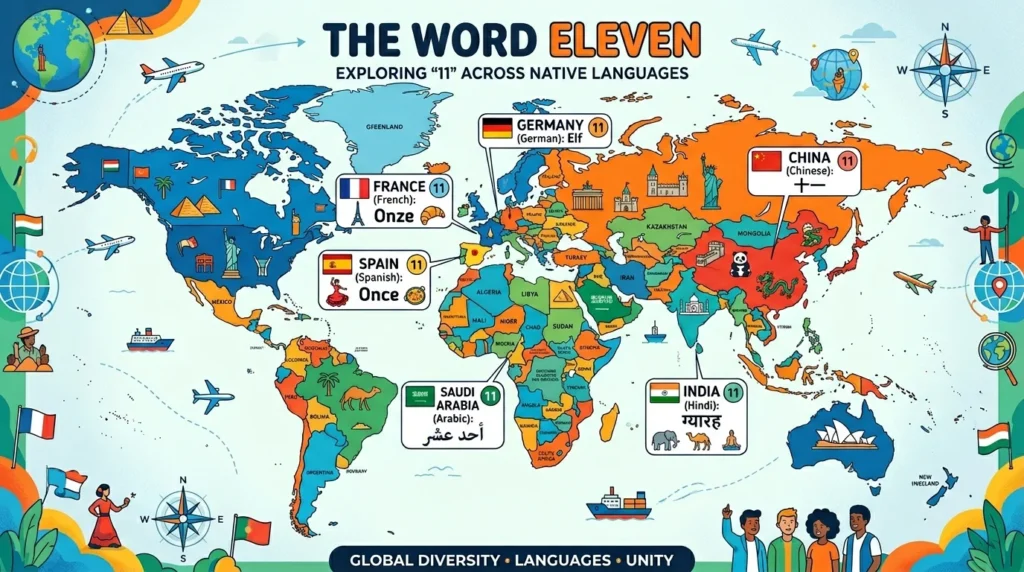
Below is a clean, mobile-friendly table showing exactly 110 different languages. Each entry includes the language or country flag, the correct native word for eleven, and an easy English pronunciation. The format is optimized for readability and featured snippets.
| Language / Flag | Native Phrase | Easy Pronunciation |
| English | Eleven | uh-lev-en |
| American English 🇺🇸 | Eleven | uh-lev-en |
| British English 🇬🇧 | Eleven | uh-lev-en |
| Spanish 🇪🇸 | Once | on-seh |
| French 🇫🇷 | Onze | onz |
| German 🇩🇪 | Elf | elf |
| Italian 🇮🇹 | Undici | un-dee-chee |
| Portuguese 🇵🇹 | Onze | onz |
| Brazilian Portuguese 🇧🇷 | Onze | on-zee |
| Dutch 🇳🇱 | Elf | elf |
| Swedish 🇸🇪 | Elva | el-va |
| Norwegian 🇳🇴 | Elleve | el-leh-veh |
| Danish 🇩🇰 | Elleve | el-leh-veh |
| Icelandic 🇮🇸 | Ellefu | el-leh-foo |
| Finnish 🇫🇮 | Yksitoista | ook-see-toy-sta |
| Estonian 🇪🇪 | Üksteist | ooks-taste |
| Latvian 🇱🇻 | Vienpadsmit | vee-en-pad-smit |
| Lithuanian 🇱🇹 | Vienuolika | vee-eh-noo-oh-lee-ka |
| Polish 🇵🇱 | Jedenaście | yeh-deh-nash-che |
| Czech 🇨🇿 | Jedenáct | yeh-deh-nahtst |
| Slovak 🇸🇰 | Jedenásť | yeh-deh-nash |
| Hungarian 🇭🇺 | Tizenegy | tee-zen-etch |
| Romanian 🇷🇴 | Unsprezece | oon-spreh-zeh-che |
| Bulgarian 🇧🇬 | Единадесет | eh-dee-na-de-set |
| Serbian 🇷🇸 | Једанаест | yeh-da-na-est |
| Croatian 🇭🇷 | Jedanaest | yeh-da-na-est |
| Slovenian 🇸🇮 | Enajst | eh-nahyst |
| Bosnian 🇧🇦 | Jedanaest | yeh-da-na-est |
| Macedonian 🇲🇰 | Единаесет | eh-dee-na-eh-set |
| Russian 🇷🇺 | Одиннадцать | a-deen-na-tsat |
| Ukrainian 🇺🇦 | Одинадцять | o-dee-nad-tsyat |
| Belarusian 🇧🇾 | Адзінаццаць | ad-zee-na-tsat |
| Greek 🇬🇷 | Έντεκα | en-deh-ka |
| Latin | Undecim | un-deh-kim |
| Welsh 🏴 | Un ar ddeg | in ar dheg |
| Irish 🇮🇪 | Aon déag | een jayg |
| Scottish Gaelic 🏴 | Aon deug | een jook |
| Breton 🇫🇷 | Unnek | un-ek |
| Basque 🇪🇸 | Hamaika | ha-my-ka |
| Catalan 🇪🇸 | Onze | on-zuh |
| Galician 🇪🇸 | Once | on-the |
| Maltese 🇲🇹 | Ħdax | h-dash |
| Albanian 🇦🇱 | Njëmbëdhjetë | nyum-buh-dye-te |
| Turkish 🇹🇷 | On bir | on beer |
| Arabic 🇸🇦 | أحد عشر | ah-had a-shar |
| Hebrew 🇮🇱 | אחת עשרה | a-khat es-reh |
| Persian 🇮🇷 | یازده | yaz-dah |
| Urdu 🇵🇰 | گیارہ | gya-ra |
| Hindi 🇮🇳 | ग्यारह | gyaa-rah |
| Bengali 🇧🇩 | এগারো | eh-ga-ro |
| Punjabi 🇮🇳 | ਗਿਆਰਾਂ | gyaa-raan |
| Gujarati 🇮🇳 | અગિયાર | uh-gi-yaar |
| Marathi 🇮🇳 | अकरा | uh-kuh-ra |
| Tamil 🇮🇳 | பதினொன்று | pa-thi-non-ru |
| Telugu 🇮🇳 | పదకొండు | pa-da-kon-du |
| Kannada 🇮🇳 | ಹನ್ನೊಂದು | hun-non-du |
| Malayalam 🇮🇳 | പതിനൊന്ന് | pa-thi-non-nu |
| Sinhala 🇱🇰 | එකොළහ | eh-ko-la-ha |
| Nepali 🇳🇵 | एघार | eh-ghaar |
| Thai 🇹🇭 | สิบเอ็ด | sip-et |
| Vietnamese 🇻🇳 | Mười một | mu-oi muht |
| Indonesian 🇮🇩 | Sebelas | suh-buh-las |
| Malay 🇲🇾 | Sebelas | suh-buh-las |
| Filipino 🇵🇭 | Labing-isa | la-bing ee-sa |
| Chinese 🇨🇳 | 十一 | shi-yi |
| Japanese 🇯🇵 | 十一 | juu-ichi |
| Korean 🇰🇷 | 열하나 | yul-ha-na |
| Mongolian 🇲🇳 | Арван нэг | ar-van neg |
| Kazakh 🇰🇿 | Он бір | on beer |
| Uzbek 🇺🇿 | O‘n bir | on beer |
| Kyrgyz 🇰🇬 | Он бир | on beer |
| Georgian 🇬🇪 | თერთმეტი | tert-me-ti |
| Armenian 🇦🇲 | Տասնմեկ | das-n-meg |
| Swahili 🇰🇪 | Kumi na moja | koo-mee na mo-ja |
| Zulu 🇿🇦 | Ishumi nanye | ee-shoo-mee nan-ye |
| Xhosa 🇿🇦 | Ishumi elinanye | ee-shoo-mee eh-lee-nan-ye |
| Afrikaans 🇿🇦 | Elf | elf |
| Hausa 🇳🇬 | Goma sha ɗaya | go-ma sha da-ya |
| Yoruba 🇳🇬 | Mọ́kànlá | mo-kan-la |
| Igbo 🇳🇬 | Iri na otu | ee-ree na oh-too |
| Amharic 🇪🇹 | አስራ አንድ | as-ra and |
| Somali 🇸🇴 | Kow iyo toban | kow ee-yo to-ban |
| Malagasy 🇲🇬 | Iraika ambin’ny folo | ee-ray-ka |
| Maori 🇳🇿 | Tekau mā tahi | teh-kow maa ta-hee |
| Hawaiian 🇺🇸 | ʻUmi kūmākahi | oo-mee koo-maa-ka-hee |
| Samoan 🇼🇸 | Sefulu ma tasi | seh-foo-loo ma ta-see |
| Tongan 🇹🇴 | Hongofulu mā taha | hon-go-foo-loo |
| Fijian 🇫🇯 | Tinikadua | ti-ni-ka-doo-a |
| Esperanto | Dek unu | dek oo-noo |
Common Patterns of Eleven in Different Languages
Many languages follow recognizable patterns when forming the number eleven. For example, Germanic languages like English, German, and Dutch use short, unique forms such as eleven and elf. Romance languages like Spanish (once), French (onze), and Italian (undici) have evolved from Latin roots.
In contrast, many Asian and African languages build eleven by combining “ten + one.” For example, in Chinese (shi yi), Swahili (kumi na moja), and Turkish (on bir), the structure clearly reflects mathematical composition.
Understanding these patterns helps learners quickly recognize and remember numbers across multiple languages.
Why Learning Eleven in Different Languages Is Useful
Knowing eleven in different languages helps with basic communication, language learning, travel, education, and cultural understanding.
Historical Origin of the Word Eleven
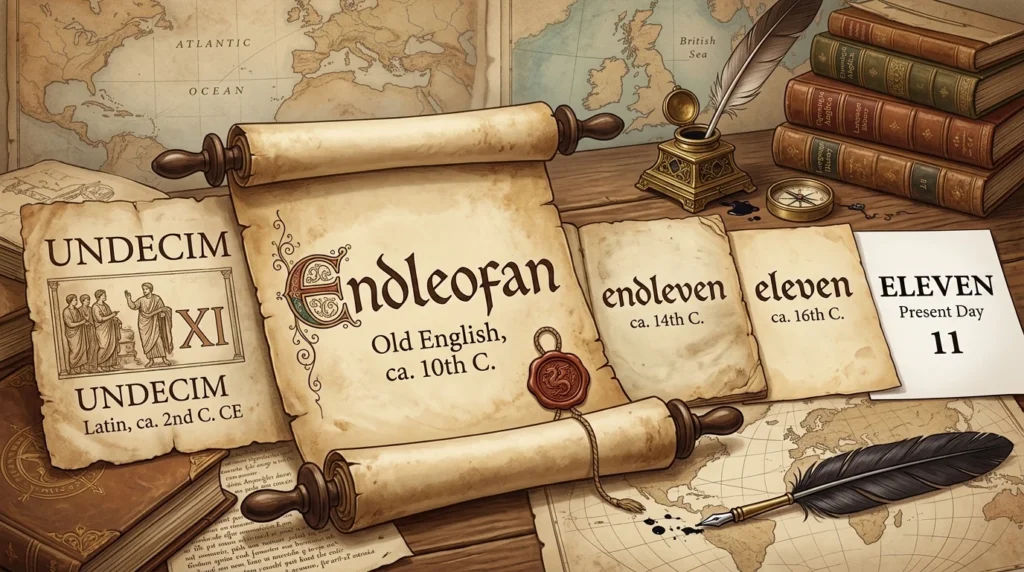
The word eleven has fascinating historical roots. In Old English, it was written as endleofan, meaning “one left after ten.” This reflects an early counting system before standardized number formation.
Similarly, many European languages have words for eleven derived from ancient linguistic systems rather than simple mathematical combinations. Latin used undecim (one + ten), which later influenced many modern languages.
This historical evolution explains why eleven often breaks normal counting patterns.
How to Say Eleven in Different Languages Correctly
Some languages follow a clear numeric pattern, while others use unique historical structures, making eleven especially interesting linguistically.
Eleven in Different Languages Around the World
Across cultures, eleven often reflects how a language builds numbers beyond ten, revealing grammar and counting traditions.
Conclusion
This guide to eleven in different languages in all languages provides accurate translations and pronunciations across 110 languages, making it a practical reference for learners, educators, and global readers.
FAQs
Q1.What does eleven mean?
Eleven is the number that comes after ten and before twelve.
Q2.Why is eleven different in many languages?
Many languages form eleven using unique historical or grammatical number systems.
Q3.Is eleven written the same way everywhere?
No, both spelling and pronunciation vary widely across languages.
Q4.Is eleven considered a special number?
In some cultures, eleven has symbolic or traditional importance.
Q5.What is the easiest way to remember eleven in other languages?
Learning patterns and pronunciations together makes memorization easier.