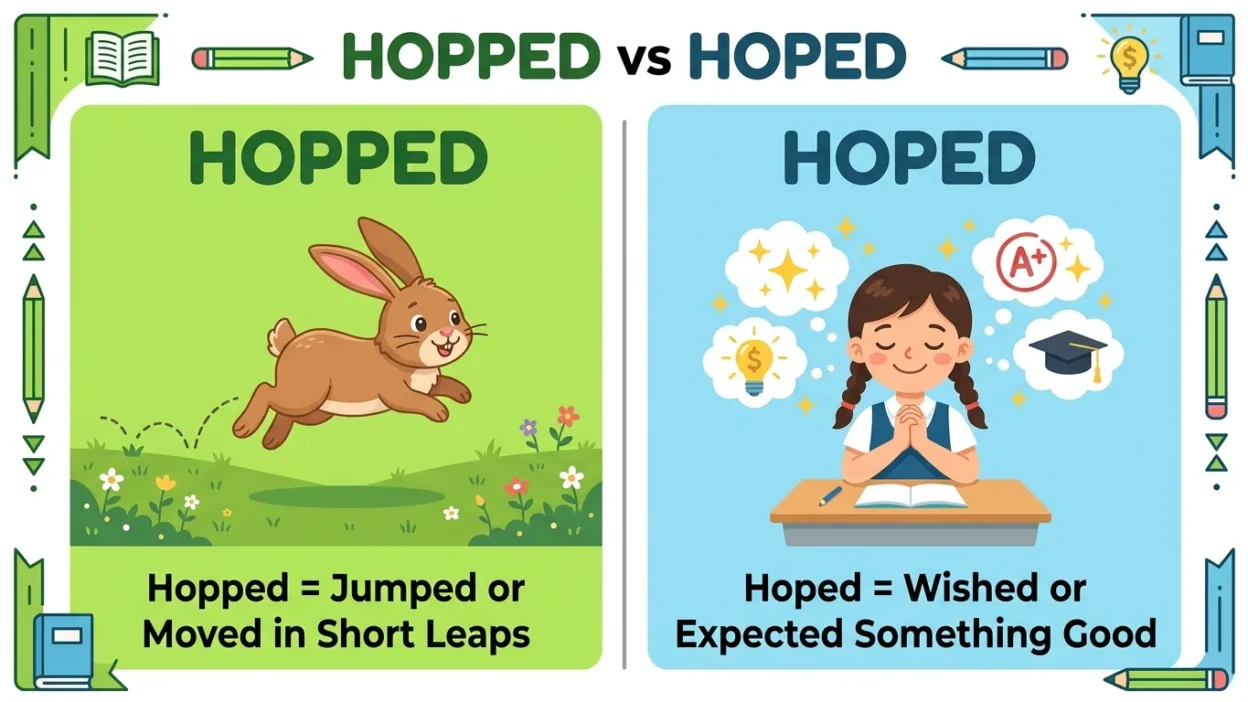
When learning hopped vs hoped, many English learners notice that the words look similar, yet their meanings are quite different in everyday writing and speech. A simple way to remember them is to focus on the base verbs hop and hope, because each word keeps a clear connection to its original action or idea.
The word hopped comes from hop and serves as both the past tense and past participle form. In the same way, hoped comes from hope and is also used as a past tense and past participle form. This pattern becomes easier to understand once you connect each verb to its root meaning.
From my experience helping learners with English spelling, these words are often mixed up because they look alike. The key difference is their meaning and origin. Use hopped for movement such as a jump, while use hoped for wishes, expectations, and feelings connected to hope.
Quick Answer
| Word | Meaning | Base Verb | Example |
| Hopped | Jumped or moved with short leaps | Hop | The rabbit hopped across the field. |
| Hoped | Wanted something good to happen | Hope | She hoped for good weather. |
Simple Rule
- Use hopped when talking about jumping or moving.
- Use hoped when talking about wishes or expectations.
- Hopped comes from hop.
- Hoped comes from hope.
Simple Background
The confusion comes from English spelling rules.
The verb hop ends with one vowel and one consonant. When forming the past tense, the final consonant doubles.
| Base Verb | Past Tense | Present Participle |
| Hop | Hopped | Hopping |
The verb hope ends with a silent e.
| Base Verb | Past Tense | Present Participle |
| Hope | Hoped | Hoping |
Because the spellings are very similar, learners often mix them up.
Understanding the Difference
What Does Hopped Mean?
Hopped is the past tense and past participle of hop.
It describes:
- Jumping
- Bouncing
- Moving in short leaps
- Quickly getting onto something
| Sentence | Meaning |
| The frog hopped into the pond. | The frog jumped. |
| The child hopped across the room. | The child moved by jumping. |
| She hopped on the bus. | She got on the bus quickly. |
| The bird hopped along the branch. | The bird moved with small jumps. |
What Does Hoped Mean?
Hoped is the past tense and past participle of hope.
It describes:
- Wanting something good
- Expecting a positive result
- Having a wish
| Sentence | Meaning |
| I hoped to see my friend. | I wanted to see my friend. |
| We hoped for better results. | We wished for better results. |
| He hoped the rain would stop. | He wanted the rain to stop. |
| They hoped for good news. | They expected something positive. |
Side-by-Side Comparison
| Feature | Hopped | Hoped |
| Base word | Hop | Hope |
| Main meaning | Jumped | Wished |
| Action or feeling | Physical action | Feeling or expectation |
| Past tense | Yes | Yes |
| Past participle | Yes | Yes |
| Related to movement | Yes | No |
| Related to wishes | No | Yes |
| Example | The rabbit hopped away. | She hoped for success. |
Which One Should You Use?
Use this table whenever you are unsure.
| If you mean… | Use |
| Jumping | Hopped |
| Small leaps | Hopped |
| Moving quickly | Hopped |
| A wish | Hoped |
| An expectation | Hoped |
| Wanting something good | Hoped |
Quick Memory Trick
| Think About | Correct Word |
| A rabbit jumping | Hopped |
| A person wishing | Hoped |
| Physical movement | Hopped |
| Thoughts and feelings | Hoped |
Common Mistakes People Make
Many learners use the wrong word because they focus only on spelling.
Mistake 1
❌ I hopped that everything would be fine.
✅ I hoped that everything would be fine.
Reason: This sentence talks about a wish, not a jump.
Mistake 2
❌ The frog hoped into the water.
✅ The frog hopped into the water.
Reason: A frog jumps. It does not wish itself into the water.
Mistake 3
❌ We hopped for good news.
✅ We hoped for good news.
Reason: Good news is something people wish for.
Mistake 4
❌ The bird hoped across the fence.
✅ The bird hopped across the fence.
Reason: The bird is moving physically.
Everyday Real-Life Examples
In Emails
| Sentence | Correct Word |
| I hoped to receive your reply soon. | Hoped |
| I hoped everything went well. | Hoped |
In News Writing
| Sentence | Correct Word |
| Investors hoped for market growth. | Hoped |
| The athlete hopped over the barrier. | Hopped |
On Social Media
| Sentence | Correct Word |
| I hoped this day would never end. | Hoped |
| My dog hopped onto the couch. | Hopped |
In Daily Conversation
| Sentence | Correct Word |
| We hoped for sunny weather. | Hoped |
| The child hopped down the stairs. | Hopped |
Learning Tips for Students and Beginners
| Tip | Explanation |
| Connect hopped with jumping | Think of a rabbit hopping. |
| Connect hoped with wishing | Think of making a wish. |
| Read example sentences | Context helps memory. |
| Practice daily | Repetition improves learning. |
| Focus on meaning first | Meaning prevents mistakes. |
Easy Practice
Choose the correct word.
| Sentence | Answer |
| The rabbit _____ across the garden. | Hopped |
| I _____ to pass the test. | Hoped |
| The bird _____ onto the fence. | Hopped |
| We _____ for good weather. | Hoped |
FAQs
Is hopped a real word?
Yes. It is the past tense and past participle of hop.
Is hoped a real word?
Yes. It is the past tense and past participle of hope.
What is the main difference between hopped and hoped?
Hopped relates to movement or jumping. Hoped relates to wishes and expectations.
Why does hopped have two p’s?
The final consonant doubles because of English spelling rules for the verb hop.
Why does hoped have one p?
The base word hope ends with a silent e, so the spelling follows a different rule.
Can hopped mean wished?
No. Hopped only relates to movement or jumping.
Can hoped mean jumped?
No. Hoped only relates to wishing or expecting something.
Which word is more common?
Both are common, but they are used in different situations depending on meaning.
Conclusion
The difference between hopped and hoped is simple once you focus on meaning. Hopped comes from hop and refers to jumping or moving in short leaps. Hoped comes from hope and refers to wishes, expectations, or wanting something good to happen. Remembering the base verbs makes it much easier to choose the correct word every time.