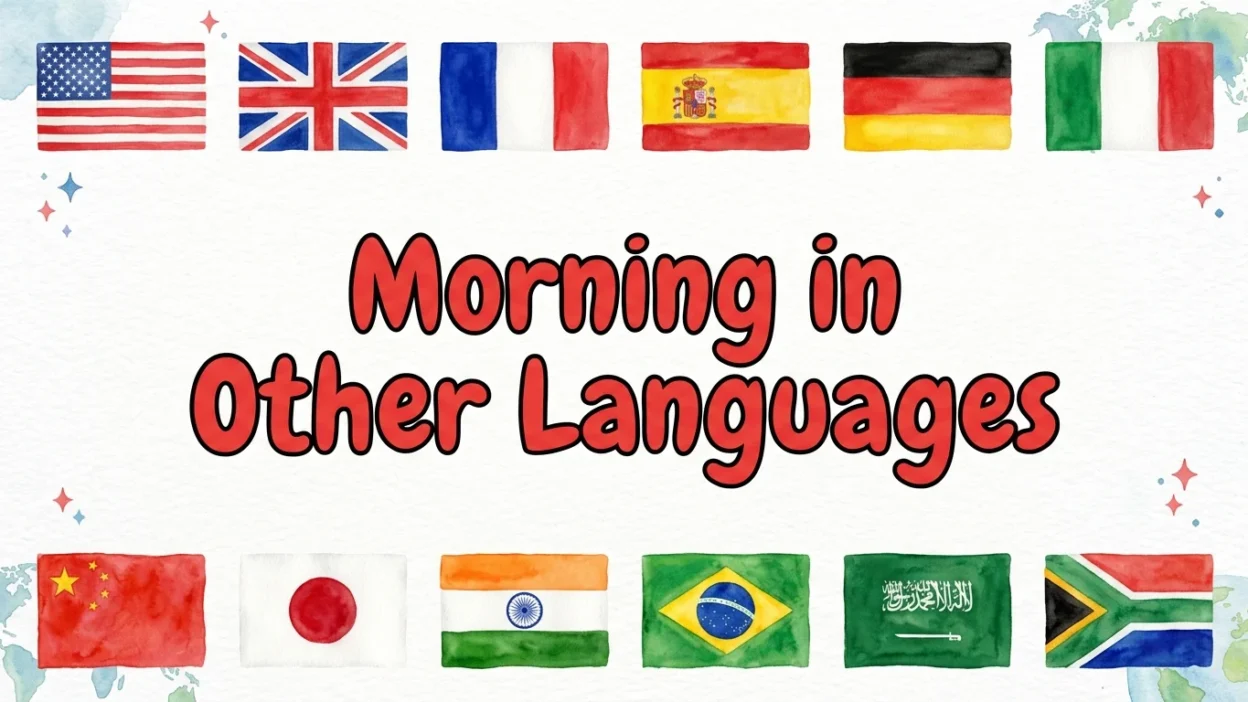
Morning is one of the most important parts of the day and is associated with fresh starts, productivity, positivity, and daily greetings. People around the world use the word morning in conversations, messages, travel, education, and business communication. Learning morning in other languages is a great way to expand vocabulary and connect with different cultures.
This guide explores how to say morning in different languages, featuring native translations and easy English pronunciations. Whether you are searching for morning in all languages, studying foreign languages, or exploring morning translations around the world, this resource provides a practical collection of translations from many cultures.
Morning in Different Languages
| Language | Native Translation | Easy English Pronunciation |
| English | Morning | Mor-ning |
| Afrikaans | Oggend | Okh-end |
| Albanian | Mëngjes | Mun-jes |
| Amharic | ጠዋት | Te-waht |
| Arabic | صباح | Sa-bah |
| Armenian | Առավոտ | A-ra-vot |
| Azerbaijani | Səhər | Se-her |
| Basque | Goiza | Goi-za |
| Belarusian | Раніца | Ra-nee-tsa |
| Bengali | সকাল | Sho-kal |
| Bosnian | Jutro | Yoo-tro |
| Bulgarian | Сутрин | Soo-trin |
| Burmese | မနက် | Ma-net |
| Catalan | Matí | Ma-tee |
| Cebuano | Buntag | Boon-tag |
| Chinese (Simplified) | 早晨 | Zao-chen |
| Chinese (Traditional) | 早晨 | Zao-chen |
| Corsican | Mattina | Mat-tee-na |
| Croatian | Jutro | Yoo-tro |
| Czech | Ráno | Raa-no |
| Danish | Morgen | Mor-gen |
| Dutch | Ochtend | Okh-tent |
| Esperanto | Mateno | Ma-te-no |
| Estonian | Hommik | Hom-mik |
| Filipino | Umaga | Oo-ma-ga |
| Finnish | Aamu | Aa-moo |
| French | Matin | Ma-tan |
| Frisian | Moarn | Mo-arn |
| Galician | Mañá | Ma-nya |
| Georgian | დილა | Dee-la |
| German | Morgen | Mor-gen |
| Greek | Πρωί | Pro-ee |
| Gujarati | સવાર | Sa-vaar |
| Haitian Creole | Maten | Ma-ten |
| Hausa | Safiya | Sa-fee-ya |
| Hawaiian | Kakahiaka | Ka-ka-hee-a-ka |
| Hebrew | בוקר | Bo-ker |
| Hindi | सुबह | Su-bah |
| Hmong | Thaum Sawv Ntxov | Thaum Sao N-tso |
| Hungarian | Reggel | Reg-gel |
| Icelandic | Morgunn | Mor-gun |
| Igbo | Ụtụtụ | Oo-too-too |
| Indonesian | Pagi | Pa-gee |
| Irish | Maidin | Ma-jin |
| Italian | Mattina | Mat-tee-na |
| Japanese | 朝 | A-sa |
| Javanese | Esuk | Eh-sook |
| Kannada | ಬೆಳಗ್ಗೆ | Be-lag-ge |
| Kazakh | Таңертең | Tan-er-ten |
| Khmer | ព្រឹក | Proek |
| Korean | 아침 | A-chim |
| Kurdish | Beyanî | Be-ya-nee |
| Kyrgyz | Эртең менен | Er-ten Me-len |
| Lao | ຕອນເຊົ້າ | Ton Sao |
| Latin | Mane | Ma-ne |
How to Say Morning in Different Languages
The word morning refers to the early part of the day, typically between sunrise and noon. It is one of the first words language learners encounter because it appears in greetings, conversations, and everyday communication.
Many people search for how to say morning in different languages when learning greetings, traveling abroad, or creating multilingual content.
Morning Around the World
Morning is often associated with new beginnings, energy, and opportunity. Different cultures have unique traditions, greetings, and routines connected with the morning hours.
Understanding morning in other languages around the world can help improve communication and provide insight into global cultures.
Morning in All Languages and Cultures
The concept of morning exists in every language because it marks the beginning of a new day. While the words and pronunciations differ, the meaning remains universal.
Exploring morning in all languages helps language learners understand common greetings and daily vocabulary used around the world. Morning-related words are often among the first terms taught in language courses because they are practical and frequently used.
Common Uses of the Word Morning
The word morning appears in many everyday expressions and situations, including:
- Good morning
- Morning routine
- Morning walk
- Morning meeting
- Early morning
- Morning exercise
These phrases are commonly used in personal conversations, workplaces, schools, and travel settings.
Morning Translations Around the World
These morning translations around the world highlight the diversity of languages while showing a shared understanding of the start of the day. Whether written in Latin, Cyrillic, Arabic, Chinese, or other scripts, the meaning remains familiar across cultures.
Learning these translations can help improve communication, travel experiences, and cultural understanding.
Learning Morning in Different Languages
If you want to remember how to say morning in different languages, consider these simple methods:
- Practice pronunciation regularly
- Use greeting phrases with the word morning
- Create vocabulary flashcards
- Listen to native speakers
- Write example sentences
- Review translations often
Regular practice can make vocabulary retention easier and more effective.
Conclusion
Understanding morning in other languages is a useful way to expand your vocabulary and improve communication skills. Because morning greetings and expressions are used daily around the world, learning these translations can help travelers, students, professionals, and language enthusiasts connect with people from different cultures more confidently.
FAQs
How do you say morning in different languages?
The word morning has different translations across languages, including Matin in French, Mañana in Spanish, Morgen in German, सुबह in Hindi, and 朝 in Japanese.
Why do people search for morning in other languages?
People search for morning translations to learn greetings, improve language skills, prepare for travel, and communicate more effectively with speakers of other languages.
Is morning used the same way in every language?
While the core meaning is similar, some languages use different expressions depending on the time of day, formality, or cultural context.
What are the most common morning greetings around the world?
Many languages have greetings equivalent to “Good Morning,” such as Bonjour in French morning usage, Buenos Días in Spanish, and Guten Morgen in German.
How can I learn morning translations quickly?
You can learn them through daily practice, pronunciation exercises, flashcards, language apps, and by using the words in real conversations.