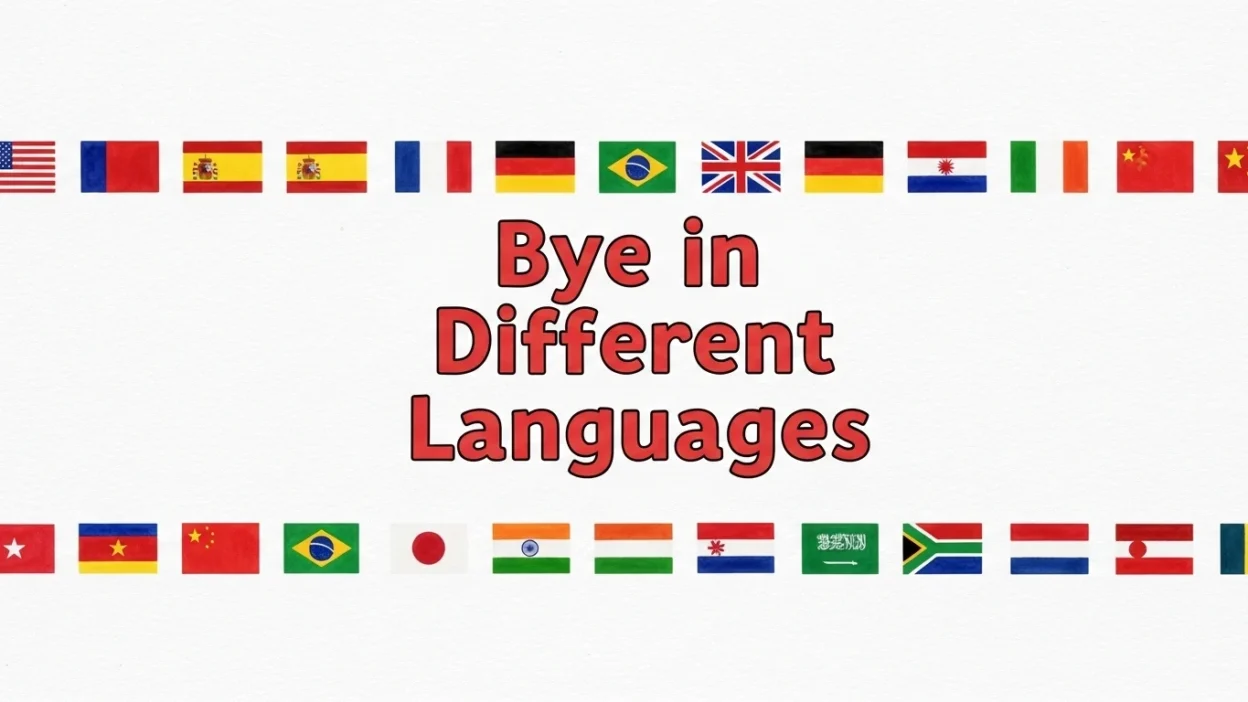
Bye is a simple but meaningful word used every day to end conversations politely. People search for bye in different languages to learn global expressions, improve communication, create multilingual content, and understand how different cultures say farewell. This article is designed to match informational search intent and clearly explain how to say bye in different languages around the world.
Below, you’ll find bye in different languages in all languages, shown in a clean, easy-to-read table that works perfectly on mobile and is optimized for featured snippets.
Bye in Different Languages
| Language / Flag | Native Phrase | Easy English Pronunciation |
| English 🇬🇧 | Bye | bye |
| Spanish 🇪🇸 | Adiós | ah-dee-os |
| French 🇫🇷 | Au revoir | oh ruh-vwar |
| German 🇩🇪 | Tschüss | choos |
| Italian 🇮🇹 | Ciao | chow |
| Portuguese 🇵🇹 | Tchau | chow |
| Dutch 🇳🇱 | Dag | dag |
| Russian 🇷🇺 | Пока | pa-ka |
| Arabic 🇸🇦 | وداعًا | wa-da-an |
| Chinese (Mandarin) 🇨🇳 | 再见 | zai-jyen |
| Japanese 🇯🇵 | さようなら | sa-yo-na-ra |
| Korean 🇰🇷 | 안녕 | an-nyeong |
| Hindi 🇮🇳 | अलविदा | al-vi-da |
| Urdu 🇵🇰 | خدا حافظ | khu-da ha-fiz |
| Bengali 🇧🇩 | বিদায় | bi-daay |
| Punjabi 🇮🇳 | ਅਲਵਿਦਾ | al-vi-da |
| Tamil 🇮🇳 | விடைபெறுகிறேன் | vi-dai-pe-ru-gi-ren |
| Telugu 🇮🇳 | వీడ్కోలు | veed-ko-lu |
| Marathi 🇮🇳 | निरोप | ni-rop |
| Gujarati 🇮🇳 | અલવિદા | al-vi-da |
| Kannada 🇮🇳 | ವಿದಾಯ | vi-da-ya |
| Malayalam 🇮🇳 | വിട | vi-da |
| Sinhala 🇱🇰 | සමුගන්නම් | sa-mu-gan-nam |
| Nepali 🇳🇵 | बिदा | bi-da |
| Thai 🇹🇭 | ลาก่อน | la-gon |
| Vietnamese 🇻🇳 | Tạm biệt | tam byet |
| Indonesian 🇮🇩 | Sampai jumpa | sam-pai joom-pa |
| Malay 🇲🇾 | Selamat tinggal | seh-la-mat ting-gal |
| Filipino 🇵🇭 | Paalam | pa-a-lam |
| Swahili 🇰🇪 | Kwaheri | kwa-he-ree |
| Zulu 🇿🇦 | Sala kahle | sa-la ka-hle |
| Afrikaans 🇿🇦 | Totsiens | tot-seens |
| Yoruba 🇳🇬 | O dabọ | o da-bo |
| Igbo 🇳🇬 | Ka ọ dị | ka o dee |
| Hausa 🇳🇬 | Sai anjima | sai an-ji-ma |
| Greek 🇬🇷 | Αντίο | an-dee-o |
| Turkish 🇹🇷 | Hoşça kal | hosh-cha kal |
| Persian 🇮🇷 | خداحافظ | kho-da-ha-fez |
| Pashto 🇦🇫 | خدای پامان | khu-day pa-man |
| Hebrew 🇮🇱 | להתראות | leh-hit-ra-ot |
| Polish 🇵🇱 | Do widzenia | do ve-dze-nya |
| Czech 🇨🇿 | Sbohem | sbo-hem |
| Slovak 🇸🇰 | Dovidenia | do-vi-de-nya |
| Hungarian 🇭🇺 | Viszlát | vees-lat |
| Romanian 🇷🇴 | La revedere | la re-ve-de-re |
| Bulgarian 🇧🇬 | Довиждане | do-vizh-da-ne |
| Serbian 🇷🇸 | Довиђења | do-vee-jen-ya |
| Croatian 🇭🇷 | Zbogom | zbo-gom |
| Bosnian 🇧🇦 | Doviđenja | do-vee-jen-ya |
| Slovenian 🇸🇮 | Nasvidenje | nas-vi-den-ye |
| Ukrainian 🇺🇦 | До побачення | do po-ba-chen-nya |
| Lithuanian 🇱🇹 | Viso gero | vee-so ghe-ro |
| Latvian 🇱🇻 | Uz redzēšanos | ooz red-ze-sha-nos |
| Estonian 🇪🇪 | Head aega | hed ai-ga |
| Finnish 🇫🇮 | Hei hei | hey hey |
| Swedish 🇸🇪 | Hejdå | hey-do |
| Norwegian 🇳🇴 | Ha det | ha det |
| Danish 🇩🇰 | Farvel | far-vel |
| Icelandic 🇮🇸 | Bless | bless |
| Irish 🇮🇪 | Slán | slawn |
| Welsh | Hwyl fawr | huil vaur |
| Scots Gaelic | Mar sin leat | mar shin lat |
| Maltese 🇲🇹 | Saħħa | sah-ha |
| Albanian 🇦🇱 | Mirupafshim | mee-roo-paf-shim |
| Armenian 🇦🇲 | Ցտեսություն | tse-te-soo-tyun |
| Georgian 🇬🇪 | ნახვამდის | nakh-vam-dis |
| Kazakh 🇰🇿 | Сау бол | sa-oo bol |
| Uzbek 🇺🇿 | Xayr | khair |
| Turkmen 🇹🇲 | Sag bol | sag bol |
| Mongolian 🇲🇳 | Баяртай | ba-yar-tai |
| Tibetan 🇹🇧 | ཕྱི་མཇལ | chi-jal |
| Lao 🇱🇦 | ລາກ່ອນ | la-gon |
| Khmer 🇰🇭 | លាហើយ | lea-hai |
| Burmese 🇲🇲 | နှုတ်ဆက်ပါတယ် | noot-set-pa-te |
| Amharic 🇪🇹 | ቻው | chow |
| Somali 🇸🇴 | Nabad gelyo | na-bad gel-yo |
| Malagasy 🇲🇬 | Veloma | ve-loo-ma |
| Maori 🇳🇿 | Poroporoaki | po-ro-po-ro-a-ki |
| Samoan 🇼🇸 | Tofa | to-fa |
| Tongan 🇹🇴 | Mālō ‘aupito | ma-lo ow-pee-to |
| Hawaiian 🇺🇸 | Aloha | a-lo-ha |
| Luxembourgish 🇱🇺 | Äddi | eh-dee |
| Catalan 🇪🇸 | Adéu | a-deu |
| Basque 🇪🇸 | Agur | a-gur |
| Galician 🇪🇸 | Adeus | a-de-os |
| Esperanto | Ĝis revido | jis re-vee-do |
| Latin 🇻🇦 | Vale | va-le |
Why Learning Bye in Different Languages Matters
Knowing bye in different languages helps people end conversations politely across cultures. It’s useful for travelers, language learners, writers, and anyone creating international or multilingual content.
Bye in Different Languages Around the World
Although bye always means a farewell, its tone can vary. Some cultures prefer formal goodbyes, while others use casual or friendly expressions. These bye in different languages translations reflect cultural differences worldwide.
Conclusion
Learning bye in different languages makes communication more respectful and culturally aware. Whether for daily use, education, or global content creation, these translations help you say goodbye with confidence.
FAQs
1. What does bye mean in different languages?
Bye generally means farewell or leaving, though wording and tone vary across languages.
2. Why do people search for bye in different languages?
People search to learn polite farewells, improve communication, and create multilingual content.
3. Is bye formal or informal in all languages?
Some languages have both formal and informal goodbyes, depending on context.
4. Are bye translations the same worldwide?
No, each language has its own farewell word shaped by culture and usage.
5. Can learning bye in different languages help us?
Yes, it improves topical relevance, supports global search intent, and strengthens multilingual content.