A city is one of the most important concepts in human civilization. Whether you are traveling, studying languages, writing international content, or exploring global cultures, learning how to say “city” in different languages can be useful and fascinating.
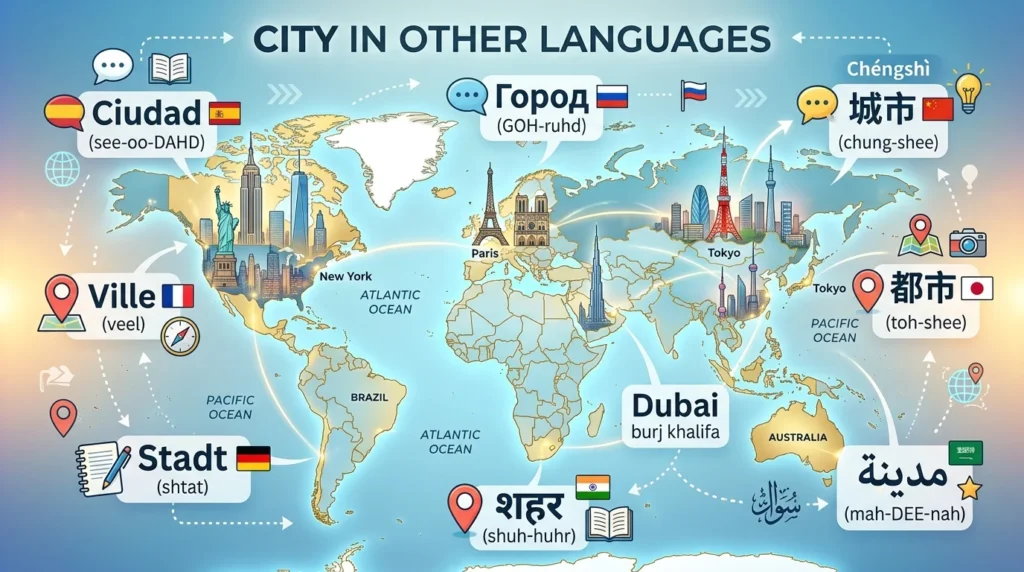
This guide covers city in other languages, helping you discover city translations from around the world. If you have ever wondered how to say city in different languages, this comprehensive resource provides easy pronunciations and native spellings for quick learning.
City in Other Languages in All Languages
| Language | Translation | Pronunciation |
| English | City | SIT-ee |
| Spanish | Ciudad | see-oo-DAD |
| French | Ville | VEEL |
| German | Stadt | SHTAHT |
| Italian | Città | chit-TAH |
| Portuguese | Cidade | see-DAH-jee |
| Dutch | Stad | STAHT |
| Swedish | Stad | STAHD |
| Norwegian | By | BEE |
| Danish | By | BEE |
| Finnish | Kaupunki | KOW-poon-kee |
| Icelandic | Borg | BORG |
| Irish | Cathair | KAH-hir |
| Welsh | Dinas | DIN-as |
| Scottish Gaelic | Baile | BAL-yeh |
| Greek | Πόλη | PO-lee |
| Russian | Город | GO-rad |
| Ukrainian | Місто | MEES-to |
| Belarusian | Горад | HO-rad |
| Polish | Miasto | MYAS-to |
| Czech | Město | MYES-to |
| Slovak | Mesto | MES-to |
| Slovenian | Mesto | MES-to |
| Croatian | Grad | GRAHD |
| Serbian | Град | GRAHD |
| Bosnian | Grad | GRAHD |
| Macedonian | Град | GRAHD |
| Bulgarian | Град | GRAHD |
| Romanian | Oraș | O-rash |
| Albanian | Qytet | CHOO-tet |
| Hungarian | Város | VAA-rosh |
| Estonian | Linn | LIN |
| Latvian | Pilsēta | PIL-say-ta |
| Lithuanian | Miestas | MYES-tas |
| Turkish | Şehir | SHE-hir |
| Azerbaijani | Şəhər | SHE-her |
| Kazakh | Қала | KA-la |
| Uzbek | Shahar | SHA-har |
| Turkmen | Şäher | SHA-her |
| Kyrgyz | Шаар | SHA-ar |
| Tajik | Шаҳр | SHAHR |
| Persian | شهر | SHAHR |
| Pashto | ښار | SHAAR |
| Urdu | شہر | SHEHR |
| Hindi | शहर | SHEH-ar |
| Punjabi | ਸ਼ਹਿਰ | SHEH-ir |
| Gujarati | શહેર | SHEH-er |
| Marathi | शहर | SHA-har |
| Bengali | শহর | SHO-hor |
| Assamese | চহৰ | SO-hor |
| Odia | ସହର | SO-hor |
| Nepali | शहर | SHA-har |
| Sinhala | නගරය | NA-ga-ra-ya |
| Tamil | நகரம் | NA-ga-ram |
| Telugu | నగరం | NA-ga-ram |
| Kannada | ನಗರ | NA-ga-ra |
| Malayalam | നഗരം | NA-ga-ram |
| Sanskrit | नगरम् | NA-ga-ram |
| Arabic | مدينة | ma-DEE-na |
| Hebrew | עיר | EER |
| Amharic | ከተማ | ke-TE-ma |
| Somali | Magaalo | ma-GAA-lo |
| Swahili | Jiji | JEE-jee |
| Zulu | Idolobha | ee-do-LO-ba |
| Xhosa | Isixeko | ee-see-KHE-ko |
| Afrikaans | Stad | STAHT |
| Yoruba | Ilu | EE-loo |
| Igbo | Obodo | o-BO-do |
| Hausa | Birni | BEER-nee |
| Shona | Guta | GOO-ta |
| Kinyarwanda | Umujyi | oo-moo-JEE |
| Malagasy | Tanàna | ta-NA-na |
| Chinese (Mandarin) | 城市 | CHENG-shrr |
| Cantonese | 城市 | SING-see |
| Japanese | 都市 | TO-shee |
| Korean | 도시 | DO-shee |
| Vietnamese | Thành phố | TAN-fo |
| Thai | เมือง | MUEANG |
| Lao | ເມືອງ | MUEANG |
| Khmer | ទីក្រុង | TEE-krong |
| Burmese | မြို့ | MYO |
| Mongolian | Хот | HOT |
| Tibetan | གྲོང་ཁྱེར | DRONG-khyer |
| Indonesian | Kota | KO-ta |
| Malay | Bandar | BAN-dar |
| Javanese | Kutha | KOO-tha |
| Sundanese | Kota | KO-ta |
| Tagalog | Lungsod | LOONG-sod |
| Cebuano | Siyudad | see-yoo-DAD |
| Maori | Taone | TAW-neh |
| Samoan | Aai | AH-ai |
| Tongan | Kolo | KO-lo |
| Fijian | Koro | KO-ro |
| Hawaiian | Kūlanakauhale | koo-la-na-kow-HA-le |
| Chamorro | Siudat | see-yoo-DAT |
| Inuktitut | ᓄᓇᓕᒃ | noo-NA-lik |
| Greenlandic | Illoqarfik | il-LO-fa-rik |
| Navajo | Kinłání | kin-LAH-nee |
| Quechua | Llaqta | YAK-ta |
| Aymara | Marka | MAR-ka |
| Guarani | Táva | TAH-va |
| Nahuatl | Altepetl | al-te-PETL |
| Haitian Creole | Vil | VEEL |
| Luxembourgish | Stad | STAHT |
| Maltese | Belt | BELT |
| Catalan | Ciutat | see-oo-TAT |
| Basque | Hiri | HEE-ree |
| Galician | Cidade | see-DA-de |
| Corsican | Cità | chee-TA |
| Frisian | Stêd | STED |
| Breton | Kêr | KAIR |
| Occitan | Ciutat | see-oo-TAT |
How to Say City in Different Languages
The word “city” changes significantly from one language family to another. Romance languages often use words derived from Latin roots, while Germanic, Slavic, Asian, and African languages have their own unique terms.
Learning these city translations can help travelers, language learners, students, and international professionals communicate more effectively across cultures.
City Around the World
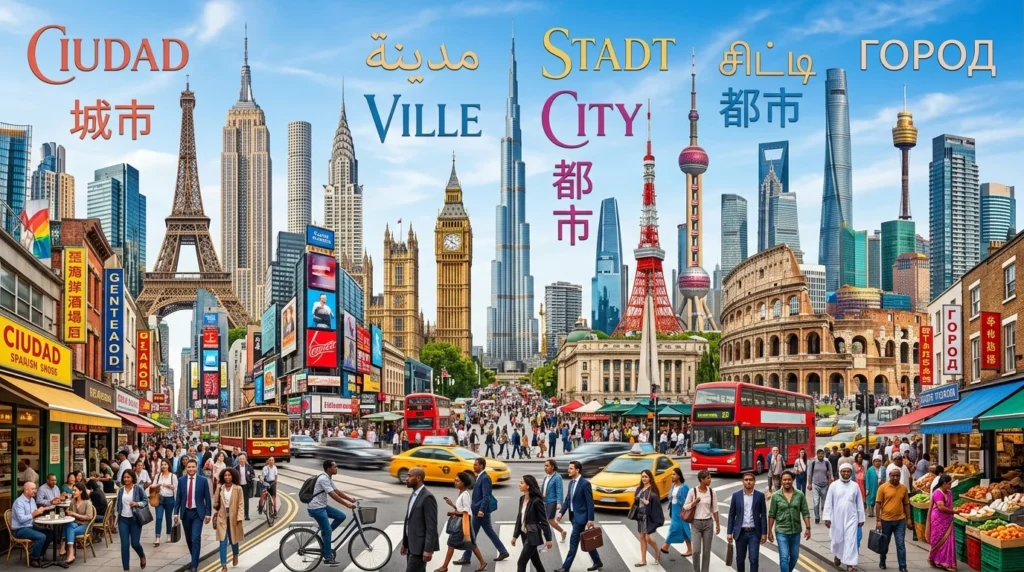
Cities are central hubs of culture, business, government, and community life. Although the pronunciation and spelling vary, the meaning remains remarkably similar worldwide.
From “Ciudad” in Spanish to “城市” in Chinese and “مدينة” in Arabic, every language reflects its own history and cultural identity.
Why Learn City Translations?
- Improve international communication
- Enhance travel experiences
- Expand language-learning skills
- Understand global cultures
- Create multilingual content more effectively
Common Uses of the Word City
The word city is commonly used in:
- Travel guides
- Maps and navigation
- International business
- Language education
- Cultural studies
- Geography and history
Conclusion
Understanding city in other languages is a great way to explore linguistic diversity and global culture. Whether you are learning a new language, traveling abroad, or researching city translations, knowing how to say city in different languages can improve communication and cultural awareness around the world.
FAQs
What is city in different languages?
City is translated differently across languages, such as Ciudad in Spanish, Ville in French, Stadt in German, and 城市 in Chinese.
How do you say city in all languages?
Every language has its own word for city. The translations listed above provide examples from major languages worldwide.
Why are city translations different?
Languages evolved independently over centuries, creating unique vocabulary and pronunciation for common concepts such as city.
What is the most common translation of city in Europe?
Common European translations include Ciudad, Ville, Stadt, Città, Cidade, and Miasto.
Is learning city in other languages useful?
Yes. It helps with travel, language learning, cultural understanding, translation work, and international communication.