Pumpkins are loved across the globe for their use in cooking, festivals, decorations, and agriculture. Whether you are learning a new language, traveling internationally, creating multilingual content, or simply curious about world cultures, knowing how to say pumpkin in different languages can be both fun and useful.
This guide explores pumpkin in other languages, featuring native translations and simple pronunciations from around the world. If you’ve ever searched for pumpkin in all languages, pumpkin translations, or how to say pumpkin in different languages, this comprehensive resource is designed for you.
Pumpkin in Other Languages in All Languages
| Language | Native Translation | Pronunciation |
| English | Pumpkin | PUMP-kin |
| Spanish | Calabaza | ka-la-BA-sa |
| French | Citrouille | see-TROO-yuh |
| German | Kürbis | KUR-bis |
| Italian | Zucca | ZOOK-ka |
| Portuguese | Abóbora | a-BO-bo-ra |
| Dutch | Pompoen | POM-poon |
| Swedish | Pumpa | POOM-pa |
| Norwegian | Gresskar | GRESS-kar |
| Danish | Græskar | GRES-kar |
| Finnish | Kurpitsa | KUR-pit-sa |
| Icelandic | Grasker | GRAS-ker |
| Irish | Puimcín | PUM-keen |
| Welsh | Pwmpen | POOM-pen |
| Scottish Gaelic | Pumpkin | PUMP-kin |
| Greek | Κολοκύθα | ko-lo-KEE-tha |
| Russian | Тыква | TIK-va |
| Ukrainian | Гарбуз | har-BOOZ |
| Belarusian | Гарбуз | har-BOOZ |
| Polish | Dynia | DIN-ya |
| Czech | Dýně | DEE-nye |
| Slovak | Tekvica | TEK-vi-tsa |
| Slovenian | Buča | BOO-cha |
| Croatian | Bundeva | boon-DE-va |
| Serbian | Бундева | boon-DE-va |
| Bosnian | Bundeva | boon-DE-va |
| Macedonian | Тиква | TIK-va |
| Bulgarian | Тиква | TIK-va |
| Romanian | Dovleac | dov-LYAK |
| Albanian | Kungull | KOON-gool |
| Hungarian | Tök | TERK |
| Estonian | Kõrvits | KUR-vits |
| Latvian | Ķirbis | KEER-bis |
| Lithuanian | Moliūgas | mo-LYOO-gas |
| Turkish | Balkabağı | bal-ka-ba-UH |
| Azerbaijani | Balqabaq | bal-ga-BAK |
| Kazakh | Асқабақ | as-ka-BAK |
| Uzbek | Qovoq | ko-VOK |
| Turkmen | Kädi | KEH-dee |
| Kyrgyz | Ашкабак | ash-ka-BAK |
| Tajik | Каду | KA-doo |
| Persian | کدو تنبل | ka-doo tan-BAL |
| Pashto | کدو | ka-DO |
| Urdu | کدو | ka-DOO |
| Hindi | कद्दू | kad-DOO |
| Punjabi | ਕੱਦੂ | kad-DOO |
| Gujarati | કોળું | KO-lu |
| Marathi | भोपळा | bho-PA-la |
| Bengali | কুমড়া | KUM-ra |
| Assamese | লাউ কুমুৰা | KOO-mu-ra |
| Odia | କଖାରୁ | ko-KHA-roo |
| Nepali | फर्सी | FAR-see |
| Sinhala | වට්ටක්කා | vat-ta-KKA |
| Tamil | பூசணி | POO-sa-ni |
| Telugu | గుమ్మడికాయ | gum-ma-di-KA-ya |
| Kannada | ಕುಂಬಳಕಾಯಿ | koom-ba-la-KA-yi |
| Malayalam | മത്തങ്ങ | mat-THAN-ga |
| Sanskrit | कूष्माण्ड | koosh-MAN-da |
| Arabic | يقطين | yaq-TEEN |
| Hebrew | דלעת | de-LA-at |
| Amharic | ዱባ | DOO-ba |
| Somali | Bocor | BO-chor |
| Swahili | Boga | BO-ga |
| Zulu | Ithanga | ee-THANG-ga |
| Xhosa | Ithanga | ee-THANG-ga |
| Afrikaans | Pampoen | PAM-poon |
| Yoruba | Elegede | e-le-GE-de |
| Igbo | Ugu | OO-goo |
| Hausa | Kabewa | ka-BE-wa |
| Shona | Nhanga | NYAN-ga |
| Kinyarwanda | Igihaza | ee-gee-HA-za |
| Malagasy | Voatavo | voo-a-TA-vo |
| Chinese (Mandarin) | 南瓜 | NAN-gwa |
| Cantonese | 南瓜 | NAM-gwaa |
| Japanese | かぼちゃ | ka-BO-cha |
| Korean | 호박 | HO-bak |
| Vietnamese | Bí ngô | bee-NGO |
| Thai | ฟักทอง | fak-TONG |
| Lao | ໝາກອຶ | mak-uh |
| Khmer | ល្ពៅ | LPOV |
| Burmese | ဖရုံသီး | pha-YON-thee |
| Mongolian | Хулуу | hoo-LOO |
| Tibetan | ཀུ་ཤུ | koo-SHOO |
| Indonesian | Labu | LA-boo |
| Malay | Labu | LA-boo |
| Javanese | Waluh | WA-looh |
| Sundanese | Waluh | WA-looh |
| Tagalog | Kalabasa | ka-la-BA-sa |
| Cebuano | Kalabasa | ka-la-BA-sa |
| Maori | Paukena | pow-KE-na |
| Samoan | Maukeni | mow-KE-ni |
| Tongan | Paukeni | pow-KE-ni |
| Fijian | Vuti | VOO-tee |
| Hawaiian | ʻUala ʻalani | oo-A-la a-LA-ni |
| Chamorro | Kalabasa | ka-la-BA-sa |
| Inuktitut | ᑯᒃᑯᓂ | kook-KOO-ni |
| Greenlandic | Kuussuaq | koo-SOO-ak |
| Navajo | Naatʼaanii łigaii | naa-TAA-nee |
| Quechua | Sapallu | sa-PAL-yoo |
| Aymara | Zapallu | za-PAL-yoo |
| Guarani | Andai | an-DAI |
| Nahuatl | Ayotli | a-YOT-lee |
| Haitian Creole | Joumou | joo-MOO |
| Luxembourgish | Kürbis | KUR-bis |
| Maltese | Qargħa | AR-ha |
| Catalan | Carbassa | kar-BA-sa |
| Basque | Kalabaza | ka-la-BA-sa |
| Galician | Cabaza | ka-BA-tha |
| Corsican | Zucca | ZOOK-ka |
| Frisian | Pompoen | POM-poon |
| Breton | Sitrouilhez | see-TROO-yez |
| Occitan | Coja | KO-ja |
How to Say Pumpkin in Different Languages
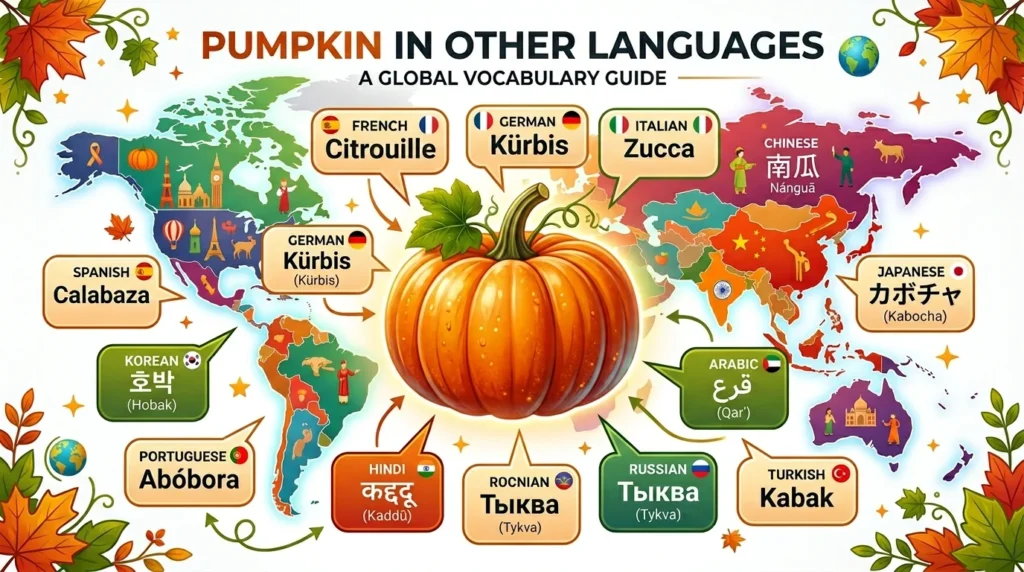
The word pumpkin varies greatly across language families. European languages often have similar roots, while Asian, African, and Indigenous languages use completely unique terms that reflect local traditions and agriculture.
Learning pumpkin translations can help language learners, travelers, food enthusiasts, and cultural researchers better understand global communication.
Pumpkin Around the World
Pumpkins are cultivated on every inhabited continent and are used in soups, desserts, pies, curries, and traditional dishes. They also play an important role in seasonal celebrations and harvest festivals.
Because pumpkins are so widely recognized, their names have become an interesting part of linguistic and cultural studies worldwide.
Why Learn Pumpkin in Other Languages?
- Improve multilingual vocabulary
- Communicate while traveling
- Understand international recipes
- Explore world cultures
- Create multilingual educational content
Common Uses of the Word Pumpkin
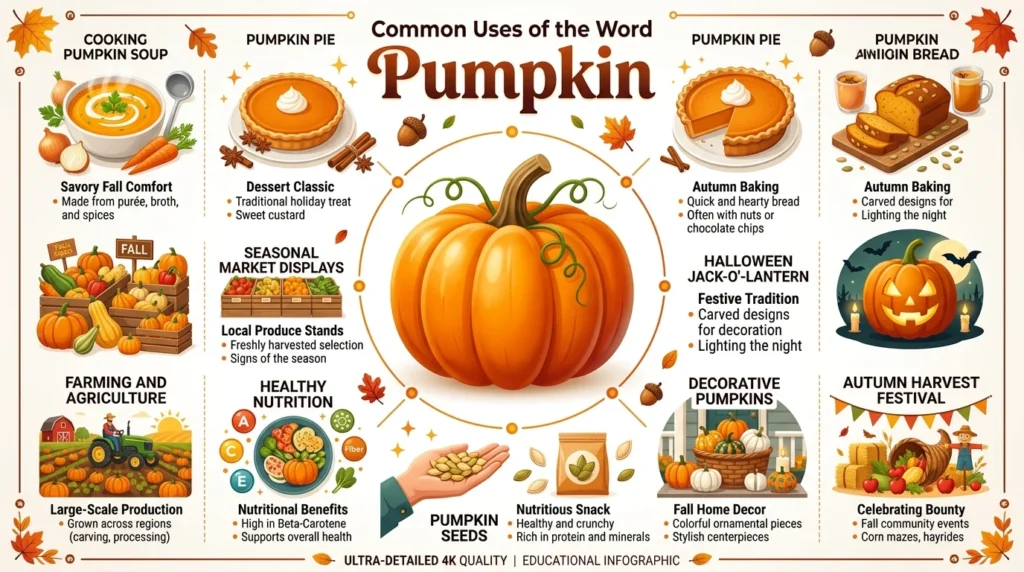
- Cooking and baking
- Gardening and farming
- Seasonal festivals
- Language learning
- Cultural studies
- International food discussions
Conclusion
Learning pumpkin in other languages is a fun way to explore global cultures and languages. From Europe and Asia to Africa and the Americas, every language has its own unique word for pumpkin. Understanding these translations can enrich travel, education, communication, and cultural appreciation.
FAQs
What is pumpkin in different languages?
Pumpkin has many translations worldwide, including Calabaza in Spanish, Citrouille in French, Kürbis in German, and 南瓜 in Chinese.
How do you say pumpkin in all languages?
Every language has its own term for pumpkin. The table above provides translations and pronunciations from 110 different languages.
Why are pumpkin translations different across languages?
Languages developed independently and were influenced by local culture, agriculture, and history, resulting in unique words for pumpkin.
Which languages use words similar to pumpkin?
English, Dutch, Afrikaans, and several Pacific languages use words that resemble the English term pumpkin.
Is learning pumpkin in other languages useful?
Yes. It helps with travel, cooking, language learning, international communication, and understanding cultural traditions around the world.