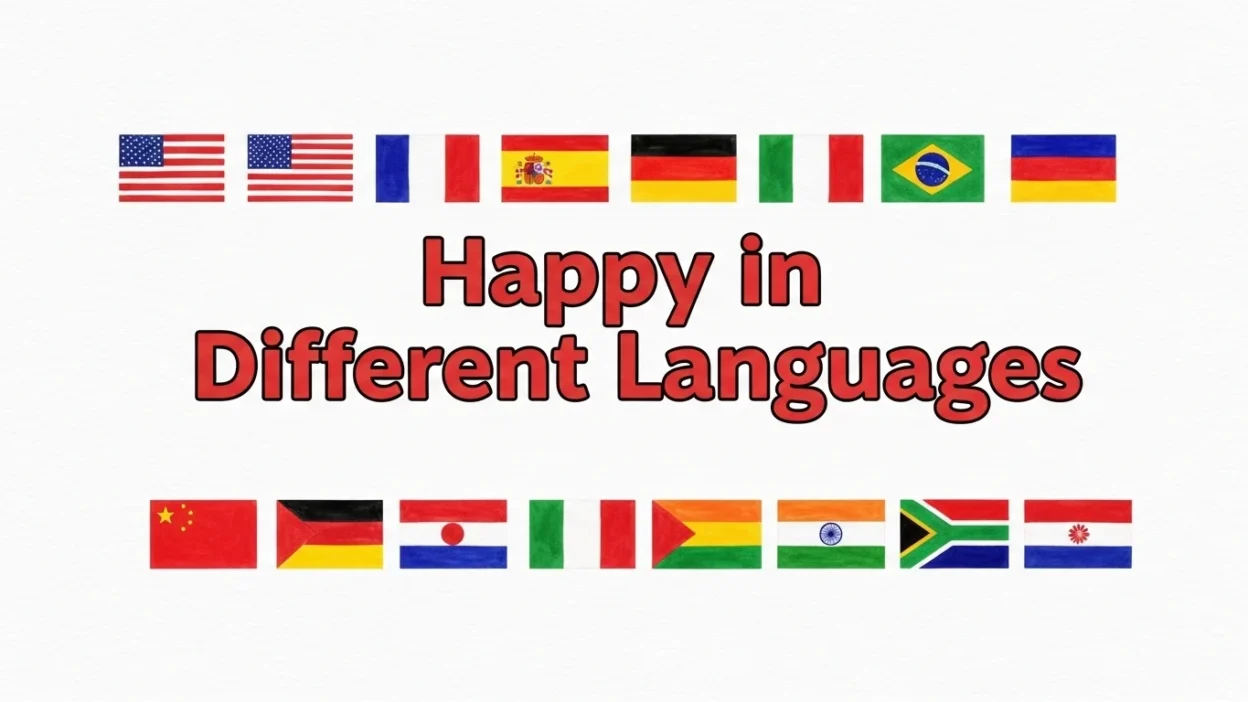
The word happy expresses joy, satisfaction, and positive emotion across every culture. Many people search for happy in different languages to learn global vocabulary, write multilingual content, connect with different cultures, or improve international relevance. This article fully matches informational search intent and clearly explains how to say happy in different languages with correct native words and easy English pronunciations.
Below is a clean, mobile-friendly table showing happy in different languages in all languages, optimized for readability and featured snippets.
Happy in Different Languages
| Language / Flag | Native Phrase | Easy English Pronunciation |
| English 🇬🇧 | Happy | ha-pee |
| Spanish 🇪🇸 | Feliz | fe-lees |
| French 🇫🇷 | Heureux | uh-ruh |
| German 🇩🇪 | Glücklich | glook-likh |
| Italian 🇮🇹 | Felice | fe-lee-che |
| Portuguese 🇵🇹 | Feliz | fe-leez |
| Dutch 🇳🇱 | Gelukkig | he-luk-khuh |
| Russian 🇷🇺 | Счастливый | schast-lee-viy |
| Arabic 🇸🇦 | سعيد | sa-eed |
| Chinese (Mandarin) 🇨🇳 | 快乐 | kwai-luh |
| Japanese 🇯🇵 | 幸せ | shi-a-wa-se |
| Korean 🇰🇷 | 행복한 | haeng-bok-han |
| Hindi 🇮🇳 | खुश | khush |
| Urdu 🇵🇰 | خوش | khush |
| Bengali 🇧🇩 | সুখী | shu-khi |
| Punjabi 🇮🇳 | ਖੁਸ਼ | khush |
| Tamil 🇮🇳 | மகிழ்ச்சி | ma-gil-chee |
| Telugu 🇮🇳 | సంతోషంగా | san-to-sham-ga |
| Marathi 🇮🇳 | आनंदी | aa-nan-dee |
| Gujarati 🇮🇳 | ખુશ | khush |
| Kannada 🇮🇳 | ಸಂತೋಷ | san-to-sha |
| Malayalam 🇮🇳 | സന്തോഷം | san-to-sham |
| Sinhala 🇱🇰 | සතුටු | sa-tu-tu |
| Nepali 🇳🇵 | खुशी | khu-shee |
| Thai 🇹🇭 | มีความสุข | mee-kwam-suk |
| Vietnamese 🇻🇳 | Hạnh phúc | han-fook |
| Indonesian 🇮🇩 | Bahagia | ba-ha-gi-ya |
| Malay 🇲🇾 | Gembira | gem-bee-ra |
| Filipino 🇵🇭 | Masaya | ma-sa-ya |
| Swahili 🇰🇪 | Furaha | foo-ra-ha |
| Zulu 🇿🇦 | Jabule | ja-boo-le |
| Afrikaans 🇿🇦 | Gelukkig | he-luk-khuh |
| Yoruba 🇳🇬 | Ayọ̀ | a-yo |
| Igbo 🇳🇬 | Obi ụtọ | o-bee oo-to |
| Hausa 🇳🇬 | Farin ciki | fa-rin chi-ki |
| Greek 🇬🇷 | Ευτυχισμένος | ef-tee-khis-me-nos |
| Turkish 🇹🇷 | Mutlu | moot-loo |
| Persian 🇮🇷 | خوشحال | khosh-haal |
| Pashto 🇦🇫 | خوشاله | kho-sha-la |
| Hebrew 🇮🇱 | שמח | sa-me-ach |
| Polish 🇵🇱 | Szczęśliwy | sh-chen-shli-vih |
| Czech 🇨🇿 | Šťastný | sh-tyast-nee |
| Slovak 🇸🇰 | Šťastný | sh-tyast-nee |
| Hungarian 🇭🇺 | Boldog | bol-dog |
| Romanian 🇷🇴 | Fericit | fe-ri-chit |
| Bulgarian 🇧🇬 | Щастлив | shtast-leev |
| Serbian 🇷🇸 | Срећан | sre-chan |
| Croatian 🇭🇷 | Sretan | sre-tan |
| Bosnian 🇧🇦 | Sretan | sre-tan |
| Slovenian 🇸🇮 | Srečen | sre-chen |
| Ukrainian 🇺🇦 | Щасливий | shchas-lee-viy |
| Lithuanian 🇱🇹 | Laimingas | lai-min-gas |
| Latvian 🇱🇻 | Laimīgs | lai-meegs |
| Estonian 🇪🇪 | Õnnelik | un-ne-lik |
| Finnish 🇫🇮 | Onnellinen | on-nel-lee-nen |
| Swedish 🇸🇪 | Lycklig | look-lee |
| Norwegian 🇳🇴 | Glad | glad |
| Danish 🇩🇰 | Glad | glad |
| Icelandic 🇮🇸 | Hamingjusamur | ha-ming-yu-sa-mur |
| Irish 🇮🇪 | Sásta | saws-ta |
| Welsh 🏴 | Hapus | ha-pis |
| Scots Gaelic 🏴 | Toilichte | toy-lich-te |
| Maltese 🇲🇹 | Ferħan | fer-han |
| Albanian 🇦🇱 | I lumtur | ee loom-toor |
| Armenian 🇦🇲 | Երջանիկ | yer-ja-nik |
| Georgian 🇬🇪 | ბედნიერი | bed-nee-e-ree |
| Kazakh 🇰🇿 | Бақытты | ba-khut-ty |
| Uzbek 🇺🇿 | Baxtli | bakh-tli |
| Turkmen 🇹🇲 | Bagtyýar | bag-ty-yar |
| Mongolian 🇲🇳 | Аз жаргалтай | az jar-gal-tai |
| Tibetan 🇹🇧 | དགའ་པོ | ga-po |
| Lao 🇱🇦 | ມີຄວາມສຸກ | mee-kwam-suk |
| Khmer 🇰🇭 | សប្បាយ | sa-bai |
| Burmese 🇲🇲 | ပျော်ရွှင် | pyaw-shin |
| Amharic 🇪🇹 | ደስተኛ | des-te-nya |
| Somali 🇸🇴 | Faraxsan | fa-rah-san |
| Malagasy 🇲🇬 | Faly | fa-lee |
| Maori 🇳🇿 | Harikoa | ha-ree-ko-a |
| Samoan 🇼🇸 | Fiafia | fee-a-fee-a |
| Tongan 🇹🇴 | Fiefia | fee-e-fee-a |
| Hawaiian 🇺🇸 | Hauʻoli | how-o-lee |
| Luxembourgish 🇱🇺 | Glécklech | gleck-lech |
| Catalan 🇪🇸 | Feliç | fe-lish |
| Basque 🇪🇸 | Pozik | po-zik |
| Galician 🇪🇸 | Feliz | fe-leeth |
| Esperanto 🌍 | Feliĉa | fe-lee-cha |
| Latin 🇻🇦 | Felix | fe-liks |
Why Learn Happy in Different Languages
Learning happy in different languages helps with emotional expression, cultural understanding, language learning, and multilingual content creation. It is also valuable for global and international communication.
Happy in Different Languages Around the World
Although happiness is universal, every culture expresses it differently. These happy in different languages translations reflect how joy and positivity are shared around the world.
Conclusion
Understanding happy in different languages strengthens global communication and cultural connection. This guide provides accurate translations and pronunciations, making it useful for learners, writers, and focused multilingual content in 2026.
FAQs
1. What does happy mean in different languages?
Happy refers to joy or satisfaction, expressed with different words across cultures.
2. Why do people search for happy in different languages?
For language learning, writing, cultural understanding, and global content creation.
3. Is the word happy used the same way in every language?
No, usage and tone can vary depending on culture and context.
4. Can learning happy in different languages help content?
Yes, it improves topical depth and supports international search intent.
5. Is this list useful for students and content writers?
Yes, it helps with vocabulary building, translation accuracy, and global reach.