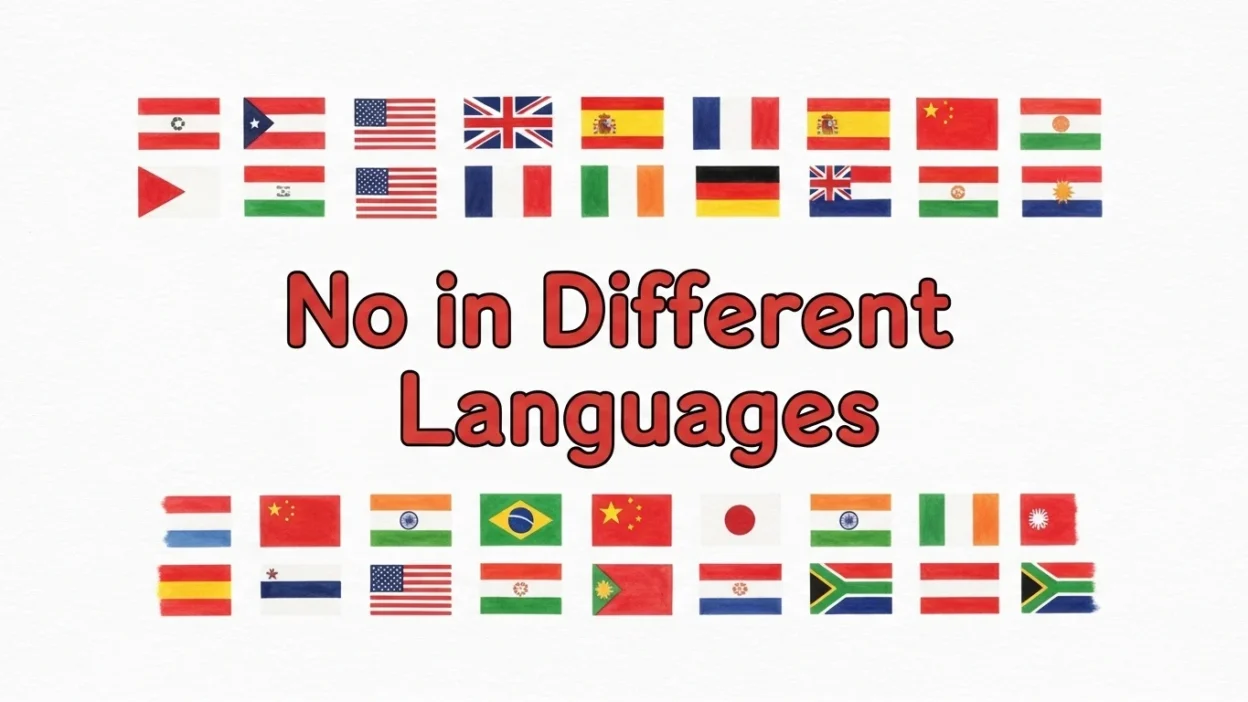
The word no is one of the most important words in any language. It helps you refuse politely, set boundaries, and communicate clearly. Learning no in different languages is useful for travel, language learning, global communication, and cultural understanding.
This guide is written to match informational search intent and provide a clear, easy reference. Below, you’ll discover how to say no in different languages, with correct native words and simple English pronunciations, all shown in one clean, mobile-friendly table optimized for featured snippets.
No in Different Languages Around the World
The table below shows exactly 110 languages, covering how people say no across cultures and regions.
| Language / Flag | Native Word for No | Easy English Pronunciation |
| English 🇺🇸 | No | noh |
| Spanish 🇪🇸 | No | noh |
| French 🇫🇷 | Non | noh |
| German 🇩🇪 | Nein | nine |
| Italian 🇮🇹 | No | noh |
| Portuguese 🇵🇹 | Não | now |
| Portuguese 🇧🇷 | Não | now |
| Dutch 🇳🇱 | Nee | nay |
| Swedish 🇸🇪 | Nej | nay |
| Norwegian 🇳🇴 | Nei | nay |
| Danish 🇩🇰 | Nej | nigh |
| Finnish 🇫🇮 | Ei | ay |
| Icelandic 🇮🇸 | Nei | nay |
| Irish 🇮🇪 | Níl | neel |
| Welsh | Na | nah |
| Polish 🇵🇱 | Nie | nyeh |
| Czech 🇨🇿 | Ne | neh |
| Slovak 🇸🇰 | Nie | nyeh |
| Hungarian 🇭🇺 | Nem | nem |
| Romanian 🇷🇴 | Nu | noo |
| Bulgarian 🇧🇬 | Не | neh |
| Serbian 🇷🇸 | Ne | neh |
| Croatian 🇭🇷 | Ne | neh |
| Slovenian 🇸🇮 | Ne | neh |
| Greek 🇬🇷 | Όχι | OH-khee |
| Russian 🇷🇺 | Нет | nyet |
| Ukrainian 🇺🇦 | Ні | nee |
| Belarusian 🇧🇾 | Не | neh |
| Turkish 🇹🇷 | Hayır | ha-YUHR |
| Arabic 🇸🇦 | لا | laa |
| Hebrew 🇮🇱 | לא | lo |
| Persian 🇮🇷 | نه | na |
| Urdu 🇵🇰 | نہیں | na-HEEN |
| Hindi 🇮🇳 | नहीं | na-HEEN |
| Bengali 🇧🇩 | না | na |
| Punjabi 🇮🇳 | ਨਹੀਂ | na-HEEN |
| Gujarati 🇮🇳 | ના | naa |
| Marathi 🇮🇳 | नाही | naa-hee |
| Tamil 🇮🇳 | இல்லை | il-lai |
| Telugu 🇮🇳 | కాదు | kaa-doo |
| Kannada 🇮🇳 | ಇಲ್ಲ | il-la |
| Malayalam 🇮🇳 | ഇല്ല | il-la |
| Sinhala 🇱🇰 | නැහැ | na-HA |
| Nepali 🇳🇵 | होइन | ho-eh-na |
| Thai 🇹🇭 | ไม่ | mai |
| Lao 🇱🇦 | ບໍ່ | baw |
| Khmer 🇰🇭 | ទេ | teh |
| Vietnamese 🇻🇳 | Không | khong |
| Indonesian 🇮🇩 | Tidak | tee-dak |
| Malay 🇲🇾 | Tidak | tee-dak |
| Filipino 🇵🇭 | Hindi | hin-DEE |
| Chinese (Simplified) 🇨🇳 | 不 | boo |
| Chinese (Traditional) 🇹🇼 | 不 | boo |
| Japanese 🇯🇵 | いいえ | ee-eh |
| Korean 🇰🇷 | 아니요 | ah-nee-yo |
| Mongolian 🇲🇳 | Үгүй | oo-gwee |
| Kazakh 🇰🇿 | Жоқ | zhok |
| Uzbek 🇺🇿 | Yo‘q | yok |
| Turkmen 🇹🇲 | Ýok | yok |
| Tajik 🇹🇯 | Не | neh |
| Georgian 🇬🇪 | არა | ah-ra |
| Armenian 🇦🇲 | Ոչ | voch |
| Azerbaijani 🇦🇿 | Xeyr | khair |
| Pashto 🇦🇫 | نه | na |
| Kurdish 🇮🇶 | Na | nah |
| Swahili 🇰🇪 | Hapana | ha-PAH-na |
| Amharic 🇪🇹 | አይ | aye |
| Somali 🇸🇴 | Maya | mah-yah |
| Hausa 🇳🇬 | A’a | ah-ah |
| Yoruba 🇳🇬 | Rárá | rah-rah |
| Igbo 🇳🇬 | Mba | mm-bah |
| Zulu 🇿🇦 | Cha | chah |
| Afrikaans 🇿🇦 | Nee | nay |
| Malagasy 🇲🇬 | Tsia | tsee-ah |
| Shona 🇿🇼 | Kwete | kwe-teh |
| Chichewa 🇲🇼 | Ayi | aye |
| Sesotho 🇱🇸 | Tjhe | chhe |
| Hawaiian 🇺🇸 | ʻAʻole | ah-oh-leh |
| Maori 🇳🇿 | Kāo | kah-oh |
| Samoan 🇼🇸 | Leai | leh-eye |
| Tongan 🇹🇴 | ʻIkai | ee-kai |
| Fijian 🇫🇯 | Sega | seh-nga |
| Haitian Creole 🇭🇹 | Non | noh |
| Luxembourgish 🇱🇺 | Nee | nay |
| Estonian 🇪🇪 | Ei | ay |
| Latvian 🇱🇻 | Nē | nay |
| Lithuanian 🇱🇹 | Ne | neh |
| Basque 🇪🇸 | Ez | es |
Why Learning No in Different Languages Is Important
Knowing no in different languages in all languages helps you communicate clearly and respectfully. It prevents misunderstandings and supports confident interaction in daily life.
How to Say No in Different Languages for Travel and Daily Use
When traveling or working abroad, understanding how to say no in different languages is essential for shopping, services, and personal boundaries.
No in Different Languages for Language Learning and Global Content
Using accurate no in different languages translations improves clarity for international audiences and helps multilingual content feel natural and user-focused.
Conclusion
The word no may be short, but it carries strong meaning everywhere. This guide to no in different languages around the world gives you a reliable reference covering 110 languages, helping you communicate clearly, politely, and confidently across cultures.
FAQs
- What is the most common way to say no worldwide?
Many languages use a short negative word similar to no, non, or ne. - Is no considered rude in some cultures?
In some cultures, direct refusal can sound strong, so tone and context matter. - Do all languages have a direct word for no?
Most languages do, though some rely more on context or verb forms. - Is learning no in different languages useful for beginners?
Yes, it is one of the most practical and essential words to learn first. - Can the word no change by region or dialect?
Yes, pronunciation or usage may vary slightly by country or region.