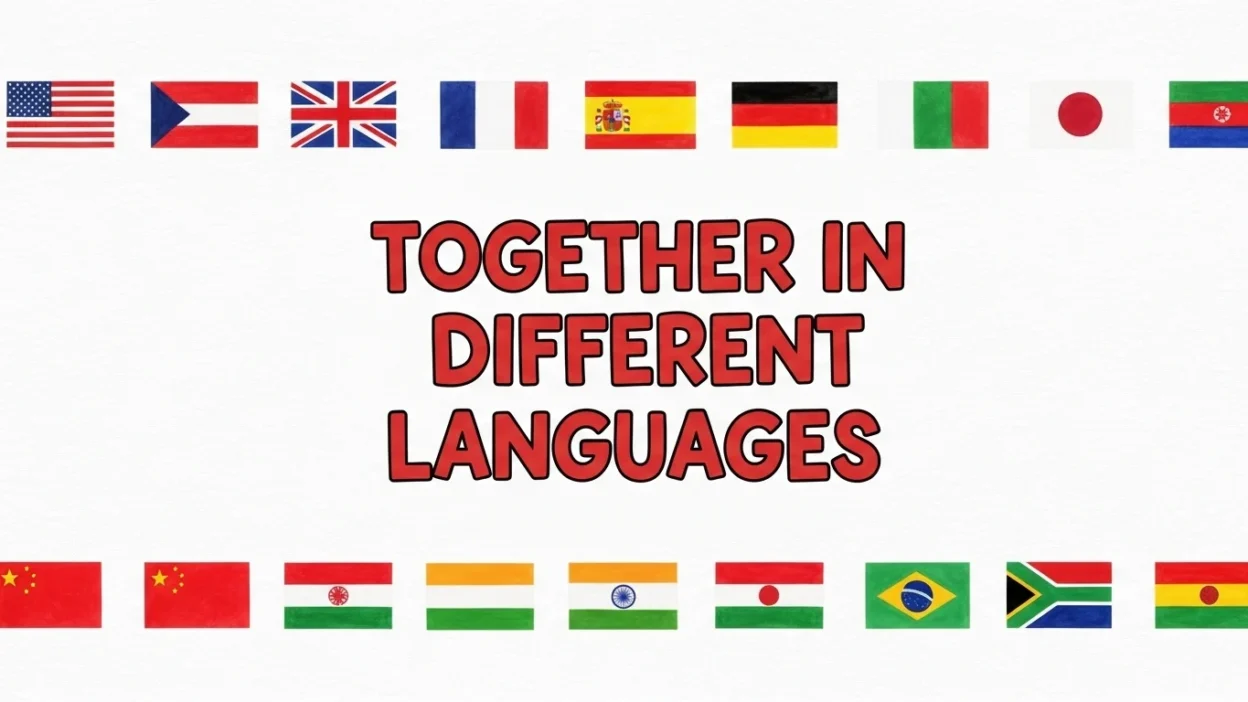
Together is a powerful word. It expresses unity, cooperation, closeness, and shared purpose. People search together in different languages to learn global expressions, create meaningful content, understand cultures, and improve communication across borders. This guide is designed for learners, writers, travelers, and anyone curious about how the idea of togetherness is expressed worldwide.
Below, you’ll find together in different languages in all languages, presented clearly and simply to match informational search intent and featured snippet requirements.
Together in Different Languages
| Language / Flag | Native Phrase | Easy English Pronunciation |
| English 🇬🇧 | Together | tuh-GETH-er |
| Spanish 🇪🇸 | Juntos | HOON-tos |
| French 🇫🇷 | Ensemble | on-SAHM-bluh |
| German 🇩🇪 | Zusammen | tsoo-ZAH-men |
| Italian 🇮🇹 | Insieme | in-SYAY-meh |
| Portuguese 🇵🇹 | Juntos | ZHOON-tos |
| Dutch 🇳🇱 | Samen | SAH-men |
| Russian 🇷🇺 | Вместе | VMES-tye |
| Arabic 🇸🇦 | معًا | ma-an |
| Chinese (Mandarin) 🇨🇳 | 一起 | ee-chee |
| Japanese 🇯🇵 | 一緒に | is-sho-nee |
| Korean 🇰🇷 | 함께 | ham-kkeh |
| Hindi 🇮🇳 | साथ | saath |
| Urdu 🇵🇰 | ساتھ | saath |
| Bengali 🇧🇩 | একসাথে | ek-sha-the |
| Punjabi 🇮🇳 | ਇਕੱਠੇ | ik-kat-the |
| Tamil 🇮🇳 | ஒன்றாக | on-raa-ga |
| Telugu 🇮🇳 | కలిసి | ka-li-see |
| Marathi 🇮🇳 | एकत्र | ek-trah |
| Gujarati 🇮🇳 | સાથે | sa-the |
| Kannada 🇮🇳 | ಒಟ್ಟಿಗೆ | ot-ti-geh |
| Malayalam 🇮🇳 | ഒരുമിച്ച് | o-ru-mich |
| Sinhala 🇱🇰 | එකට | ek-a-ta |
| Nepali 🇳🇵 | सँगै | sang-gai |
| Thai 🇹🇭 | ด้วยกัน | doi-gan |
| Vietnamese 🇻🇳 | Cùng nhau | koong nyow |
| Indonesian 🇮🇩 | Bersama | ber-sa-ma |
| Malay 🇲🇾 | Bersama | ber-sa-ma |
| Filipino 🇵🇭 | Magkasama | mag-ka-sa-ma |
| Swahili 🇰🇪 | Pamoja | pa-mo-ja |
| Zulu 🇿🇦 | Ndawonye | nda-won-ye |
| Afrikaans 🇿🇦 | Saam | sahm |
| Yoruba 🇳🇬 | Papọ̀ | pah-por |
| Igbo 🇳🇬 | Ọnụ | o-noo |
| Hausa 🇳🇬 | Tare | ta-re |
| Greek 🇬🇷 | Μαζί | ma-zee |
| Turkish 🇹🇷 | Birlikte | bir-lik-te |
| Persian 🇮🇷 | با هم | ba ham |
| Pashto 🇦🇫 | یوځای | yaw-zai |
| Hebrew 🇮🇱 | יחד | ya-khad |
| Polish 🇵🇱 | Razem | ra-zem |
| Czech 🇨🇿 | Spolu | spo-loo |
| Slovak 🇸🇰 | Spolu | spo-loo |
| Hungarian 🇭🇺 | Együtt | e-gyoot |
| Romanian 🇷🇴 | Împreună | im-preu-na |
| Bulgarian 🇧🇬 | Заедно | za-ed-no |
| Serbian 🇷🇸 | Заједно | za-yed-no |
| Croatian 🇭🇷 | Zajedno | za-yed-no |
| Bosnian 🇧🇦 | Zajedno | za-yed-no |
| Slovenian 🇸🇮 | Skupaj | sko-pie |
| Ukrainian 🇺🇦 | Разом | ra-zom |
| Lithuanian 🇱🇹 | Kartu | kar-too |
| Latvian 🇱🇻 | Kopā | ko-paa |
| Estonian 🇪🇪 | Koos | koos |
| Finnish 🇫🇮 | Yhdessä | uh-des-sa |
| Swedish 🇸🇪 | Tillsammans | till-sam-mans |
| Norwegian 🇳🇴 | Sammen | sam-men |
| Danish 🇩🇰 | Sammen | sam-men |
| Icelandic 🇮🇸 | Saman | sa-man |
| Irish 🇮🇪 | Le chéile | leh kha-leh |
| Welsh | Gyda’i gilydd | guh-die-gil-ith |
| Scots Gaelic | Còmhla | ko-vla |
| Maltese 🇲🇹 | Flimkien | flim-kyen |
| Albanian 🇦🇱 | Së bashku | suh bash-koo |
| Armenian 🇦🇲 | Միասին | mee-a-sin |
| Georgian 🇬🇪 | ერთად | er-tad |
| Kazakh 🇰🇿 | Бірге | bir-ge |
| Uzbek 🇺🇿 | Birga | bir-ga |
| Turkmen 🇹🇲 | Bile | bi-le |
| Mongolian 🇲🇳 | Хамт | hamt |
| Tibetan 🇹🇧 | མཉམ་དུ | nyam-du |
| Lao 🇱🇦 | ນຳກັນ | nam-gan |
| Khmer 🇰🇭 | ជាមួយគ្នា | jea-muoy-knea |
| Burmese 🇲🇲 | အတူ | a-too |
| Amharic 🇪🇹 | አብሮ | ab-ro |
| Somali 🇸🇴 | Wadajir | wa-da-jir |
| Malagasy 🇲🇬 | Miaraka | mee-a-ra-ka |
| Maori 🇳🇿 | Tahi | ta-hee |
| Samoan 🇼🇸 | Faatasi | faa-ta-see |
| Tongan 🇹🇴 | Fakataha | fa-ka-ta-ha |
| Hawaiian 🇺🇸 | Pū | poo |
| Luxembourgish 🇱🇺 | Zesummen | tse-sum-men |
| Catalan 🇪🇸 | Junts | joonts |
| Basque 🇪🇸 | Elkarrekin | el-ka-re-kin |
| Galician 🇪🇸 | Xuntos | shoon-tos |
| Esperanto | Kune | koo-neh |
| Latin 🇻🇦 | Una | oo-na |
Why Learning “Together” in Different Languages Matters
Understanding how to say together in different languages helps express unity in multicultural conversations. It’s useful for global content creation, language learning, branding, and cross-cultural communication.
Together in Different Languages Around the World
The meaning of together stays consistent globally, but pronunciation and cultural usage can vary. Some languages use it for emotional closeness, while others emphasize teamwork or physical presence.
Conclusion
Learning together in different languages highlights how cultures value unity and cooperation. Whether you’re creating content, learning languages, or connecting globally, these translations help you communicate shared meaning across borders.
FAQs
1. What does together mean in different languages?
Together generally means being united, joined, or acting as one, though expressions and usage vary by language.
2. Is together used the same way in all languages?
No, some languages use it mainly for people, while others also apply it to actions or ideas.
3. Why do people search together in different languages?
It’s commonly searched for learning, travel, writing, global communication, and cultural understanding.
4. Are there formal and informal ways to say things together?
In most languages, the common form works in both casual and formal contexts.
5.Can using “together” in multiple languages improve global content reach? Yes, it helps attract international audiences, increases topical depth, and improves relevance for multilingual and global search results.